For siding contractors and their crews
Every elevation measured, every square and every piece of trim counted.
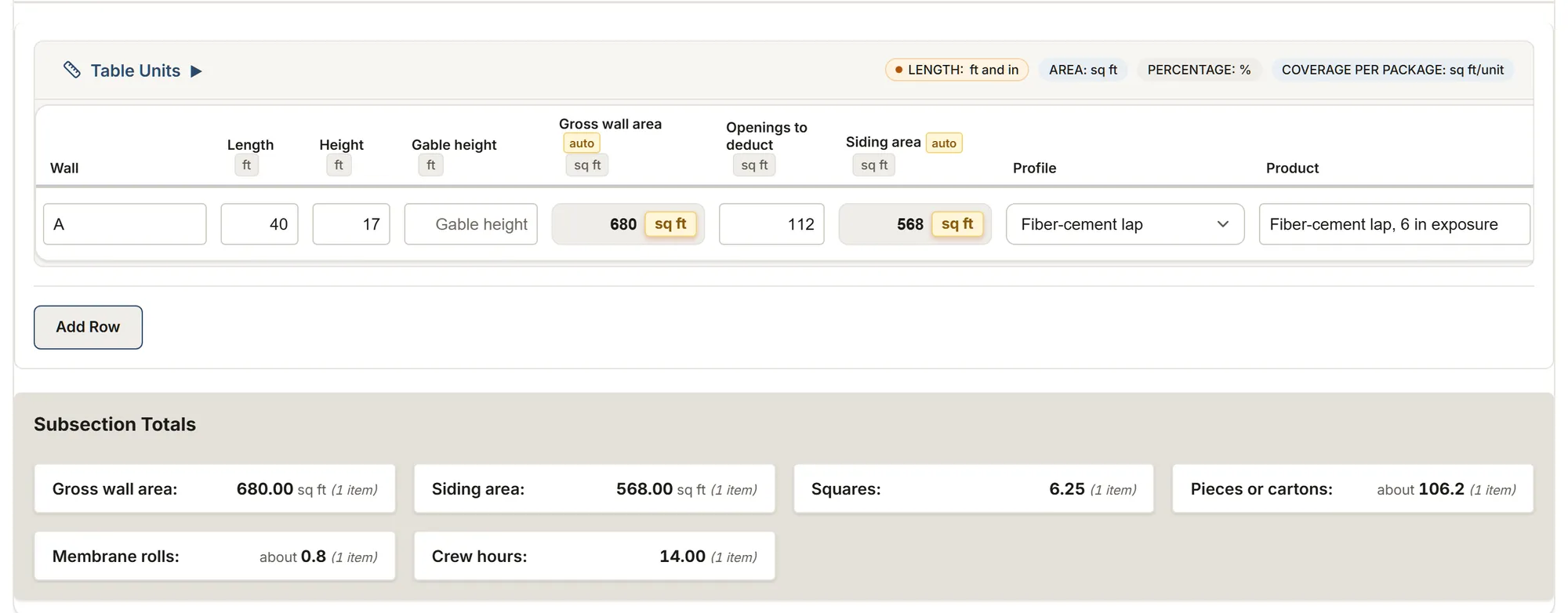
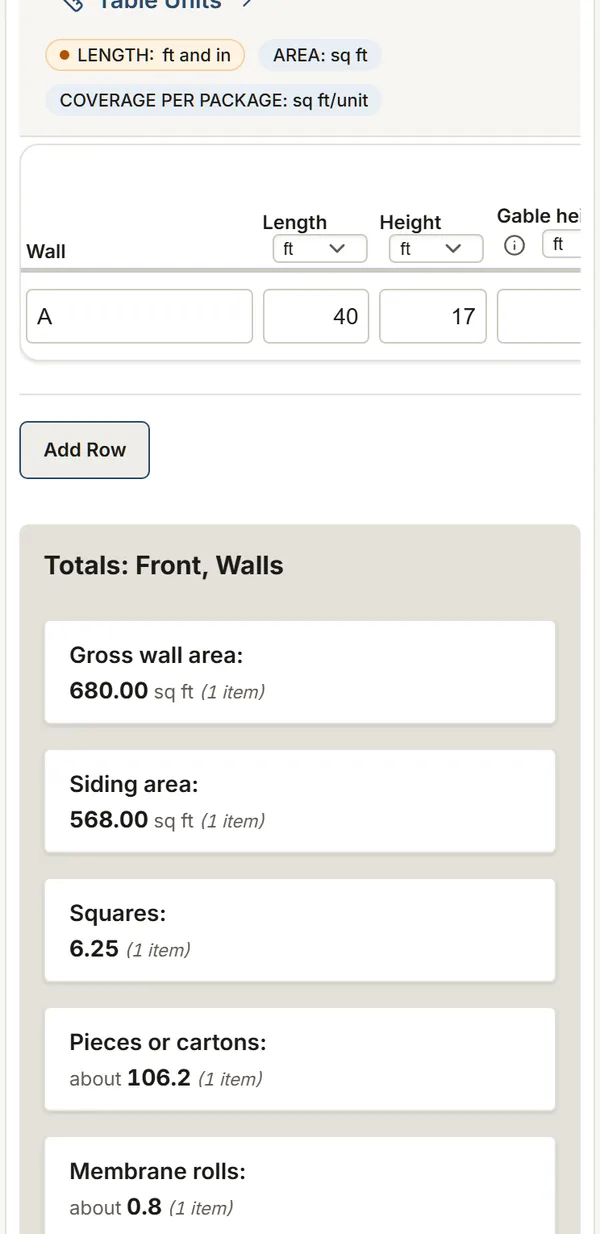
The four elevations with their walls and gables, the openings, the trim and the soffits: record the measurements on your phone, and MesuPro calculates the areas, the squares, the pieces per product, the housewrap and the furring.
No credit card. Cancel anytime.
More templates to try: Stucco repair: survey
The siding and stucco templates
Feet, inches, square feet or metric: your choice.
Siding survey
Four elevations with walls and gables, openings, trim and soffits: squares and pieces per product, housewrap, furring and old siding hazards.
You get: Gross wall area Siding area Squares
Stucco repair: survey
Stucco walls by system and area, cracks, delaminated or blistered areas, moisture readings, flashings and sealant.
You get: Wall area Damaged area
See also: Windows and window film
Building survey form: walls, openings, roof and rooms in one sheet
What you record on site
See the list (11)
- Each wall of each elevation: length, height and gable height
- Windows and doors: width, height and count
- Starter strip, J-channel, corners, drip cap and fascia
- Soffits: length, depth and venting
- Cedar shingle exposure, with the NBC's and the CSSB's maxima side by side
- The attic: the insulated ceiling area, the code's vent ratio and the share at the bottom
- Adhered stone veneer: each wall, its openings and its outside corners' running length
- The profile and the product, with its pieces per square read from the maker's chart
- Old siding hazards: asbestos-cement, lead paint, rot
- For a stucco wall to repair: its system, its size, the cracks, the delaminated or blistered areas, the moisture readings, the flashings and the sealant
- For repairs: each piece to replace on a wall, its siding type, product and color, the pieces and their length, whether new pieces can match, the cause
What MesuPro calculates for you
See the list (9)
- The area of each wall, gable included, minus the openings if you deduct them
- Squares with your waste, and pieces or cartons per product
- The trim around openings and the head flashing
- Trim pieces per product, from your piece length
- Housewrap rolls and rainscreen furring
- Each soffit's open area and the venting the code asks for the attic, to compare
- For stone veneer: the flats and corners in boxes per product, the lath, the mortar, the barrier in two layers and the weep screed
- For stucco: each wall's area less the openings, the crack length and the damaged area by type, the flashings and the sealant
- For repairs: the pieces and the length to replace by kind of piece
Nothing comes filled in: the pieces per square come from the maker's chart at your exposure, and the waste is yours (the VSI manual suggests 10%). The guide cites the IRC, the National Building Code of Canada and the makers' instructions.
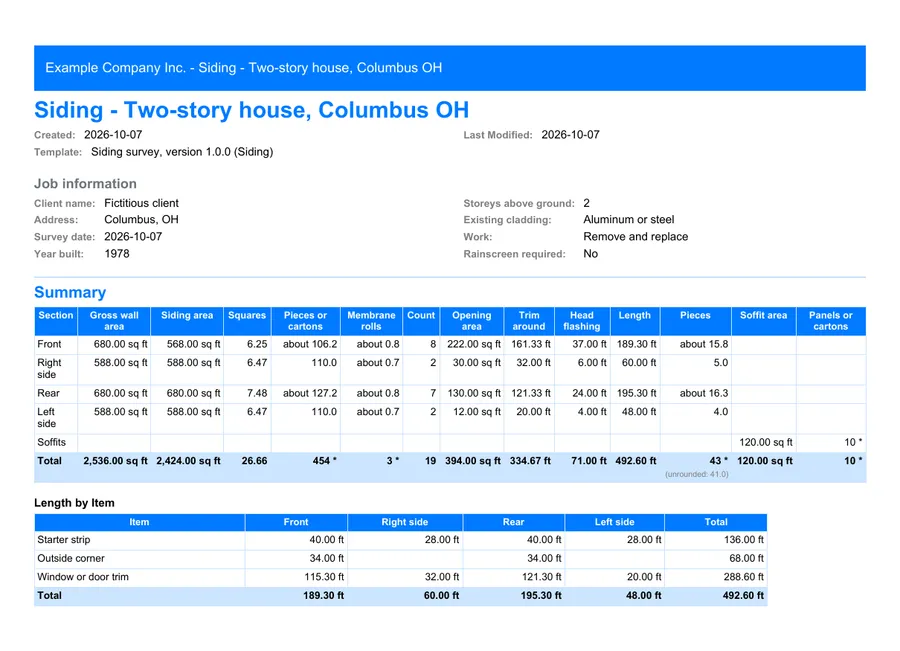
The report, as PDF or Excel
Export a PDF for the client without your crew hours, or for internal use with every column. The Excel export carries the areas and the pieces per product into your pricing.
FAQ
Where do the pieces per square come from?
From the maker's coverage chart, at the exposure you install. For vinyl, enter 1 ÷ the squares per carton. The charts include no waste: you enter it separately.
Do I deduct the windows?
Your call. The VSI manual says windows and doors are usually not deducted; the openings table gives their area if you do, and the trim around them either way.
What about cedar shingles?
Type the exposure on the wall and, in the pieces per square, the cartons or bundles at that exposure. Maibec: a red cedar carton covers 50 sq ft at 7 in and the sheet adds 3%, so 1,000 sq ft takes 21 cartons. The CSSB gives 140 sq ft per 4-bundle square of 16 in shingles at 7 in. The maximum exposure differs: the CSSB says 7 in single course for 16 in shingles, the NBC 190 mm for 400 mm; the hint gives them side by side.
What about soffit venting?
In our Columbus example, the two 40 x 1 1/2 ft soffits, vented at 6.9% net free area, open 1,192 sq in. The 1,120 sq ft attic at 1/300 (IRC R806.2 exception, half the vents at the top) asks 537.6 sq in, half of it, 268.8 sq in, at the soffits. The sheet shows both figures side by side, never a pass or fail.
What about stone veneer?
Use the Stone veneer section. In our Columbus example, a 40 x 4 ft band along the front with two 4 ft corners: 160 sq ft less half a square foot per running foot of corner (Ply Gem), so 156 sq ft of flats, 18 boxes of 10 sq ft and 2 boxes of 5 ft corners with 10% waste, 9 lath sheets of 18 sq ft and 13 bags of mortar (Sakrete: about 13 sq ft a bag). The barrier counts two layers (CMHA) and the weep screed stays 4 in above the earth (IRC R703.12).
Feet or meters?
Both. A new sheet starts in your organization's system, and a switch on the sheet goes from one to the other, converting the measurements.
What about a stucco wall to repair?
Use the stucco repair survey: one row per wall with its system (cement stucco, an acrylic finish, EIFS), then the cracks, the delaminated or blistered areas, the moisture readings and the flashings. In our Charleston example, two walls make 1,044 sq ft; 51 ft of cracks from 1/32 to 1/8 in and 29 sq ft of damage, including a blister at the porch roof edge with no kick-out flashing. The sheet records, it diagnoses nothing.
What does the code say about stucco?
The sheet cites it without applying it: the IRC 2021 R703.7 asks a weep screed at least 4 in above the earth or 2 in above paving, and R703.9 puts EIFS at least 6 in above the ground, with drainage over wood framing. Check what your state or city requires. The foundation's parging is measured in the masonry repair survey.
What about a few damaged pieces?
Use the Repairs part of the siding survey: one row per kind of piece on a wall, its siding type and product, the pieces and their length. In our Columbus example, 2 planks of 12 ft and a 12 1/2 ft J-channel make 36.5 ft to replace. The sheet asks whether the new pieces will match, never promises it, and quotes the vinyl siding manual's steps to replace a panel.
Did this page help you?