Every area, every joint and every kit counted before the quote.
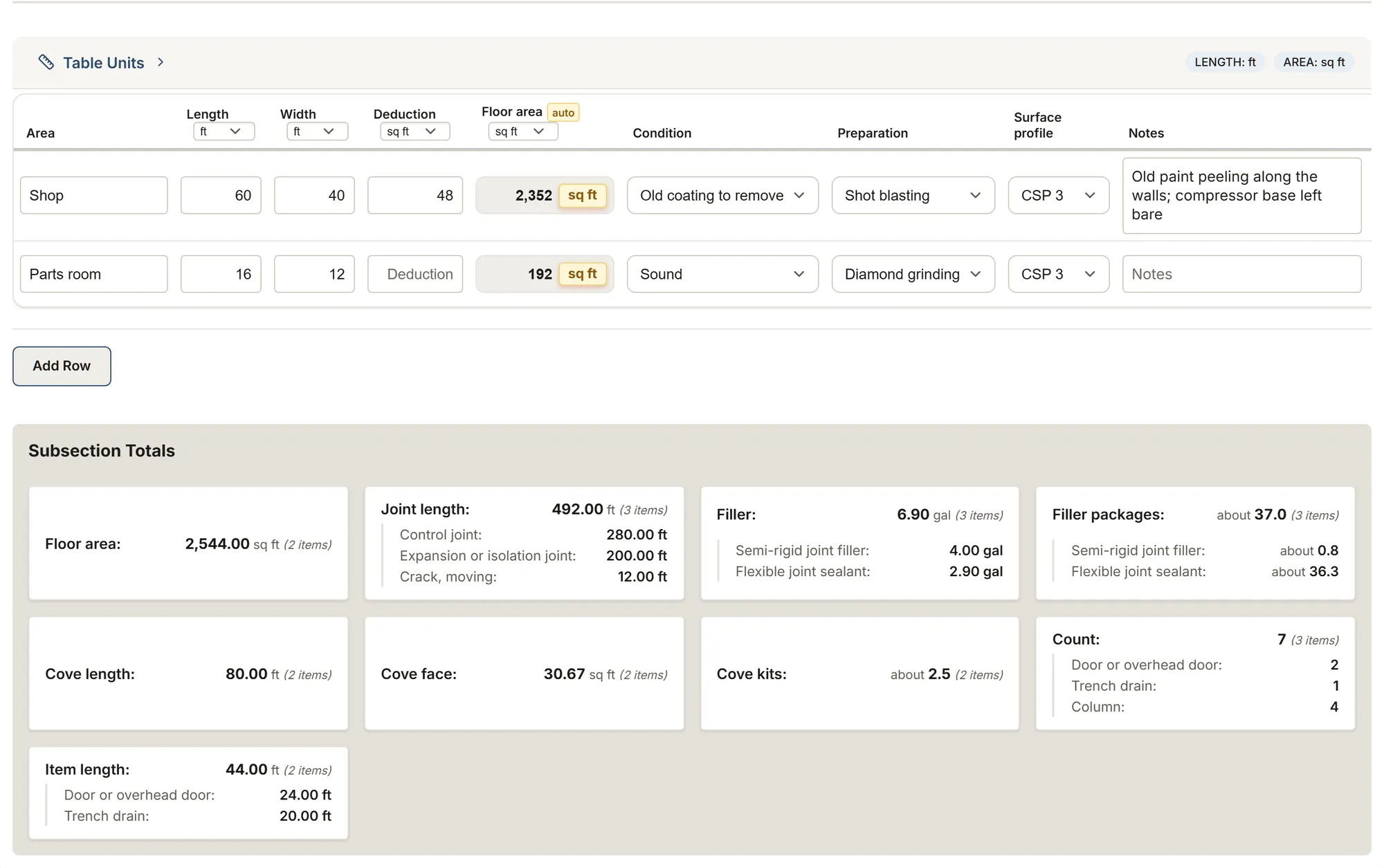
Walk the floor on your phone, garage or commercial: one space per section, one row per area, joint, moisture test and cove wall. Then one row per coat: MesuPro works out the coverage from the film thickness and volume solids, the liquid, the kits and the flakes.
No credit card. Cancel anytime.
More templates to try: Polished concrete survey
What you record on site
- Each area: its length, width and what stays bare (an equipment base, a pit)
- The slab: its age, vapor barrier, old coating, oil and hollow spots
- Joints and cracks: type, length, width and depth
- Moisture tests: calcium chloride, relative humidity in the slab or the plastic sheet, and the maker's limit
- The cove base wall by wall, the doors, drains and transitions
- Each coat: its product, film thickness, volume solids and kit size
- For polished concrete: the aggregate exposure class and appearance level agreed (CPC 2024), your grinding steps, the densifier, the guard, then the DOI and gloss readings
What MesuPro calculates for you
- The floor area of each space, less what stays bare
- The joint filler from the joints' volume, and its packages
- The theoretical coverage of each coat (1,604 sq ft per gallon at 1 mil for 100% solids), then the liquid with your loss
- The kits, rounded up once per product
- Flakes or quartz from your broadcast rate, and the boxes
- The cove face and its kits
- For polished concrete: the area ground and the hours at your rate, the densifier and guard to buy per product, the readings to take and each one's haze
No limit, thickness, rate or loss comes filled in: they come from the data sheet of the product you choose. The template's help cites several makers' figures and recommends none.
The epoxy floor and polished concrete templates
Feet, inches, square feet, mils or metric: your choice.
Epoxy floor survey
Floor areas, joints and cracks, moisture tests, cove base, doors and drains; each coat's coverage, liquid, kits, flakes and quartz.
You get: Floor area Filler Filler packages
Polished concrete survey
Ground and polished concrete: exposure class, appearance level, steps, hours, densifier, guard, DOI, gloss and haze readings.
You get: Floor to polish
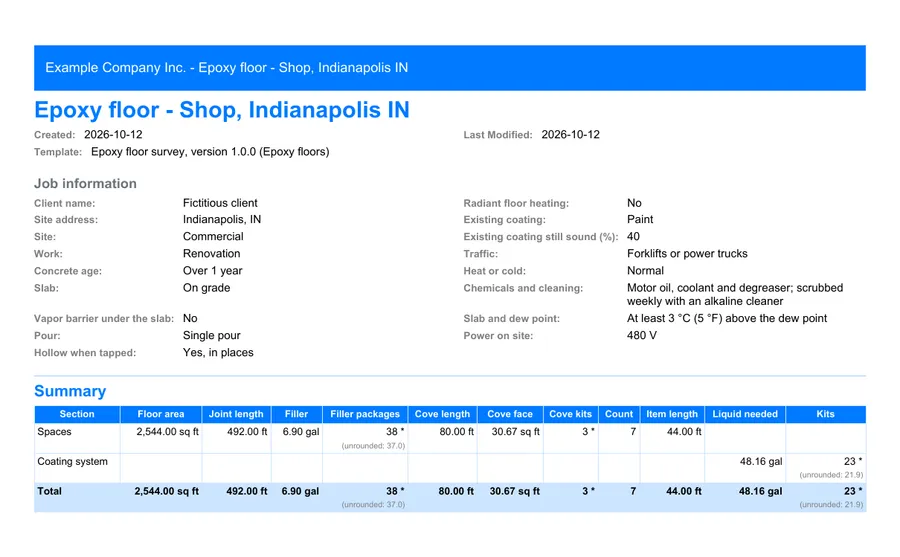
The report, ready to send
Export the survey to PDF with your photos for the client, or to Excel to bring the quantities into your quote.
FAQ
Does the template pick the product?
No: you choose the product and type the film thickness, solids and kit size from its data sheet. The help cites several makers' figures and recommends none.
How is the coverage worked out?
A US gallon of 100% solids covers 1,604 sq ft 1 mil thick: the coverage is that figure times the volume solids, divided by the film thickness. In metric, volume solids x 10 / µm gives m² per litre. Your loss comes on top.
What about moisture in the slab?
A table of tests per space: calcium chloride, relative humidity in the slab or the plastic sheet. Note the reading and the limit of the primer you plan: makers range from 3 lb per 1,000 sq ft per 24 h or 75% relative humidity to much more for moisture-tolerant primers.
What about polished concrete?
Use the polished concrete survey. In our Boise example, the 1,100 sq ft basement polished to level 3 in five steps comes to 5,500 sq ft ground, 12.2 hours at 450 sq ft an hour, and 4 readings to take before the guard: the Concrete Polishing Council asks three up to 1,000 sq ft, then one per 1,000 sq ft or part. With the garage, LION HARD densifier in two coats at 600 sq ft per gallon comes to 5.43 gallons, so 6 to buy.
A garage or a commercial floor?
Both. A garage fits in one space. For a warehouse or a commercial kitchen, click "Add a space" for each area, with its own floor, joints, moisture tests, cove and drains, and "Add a system" for a second coating system.