For fence contractors and their crews
Every run measured, every post and every bag of concrete counted.
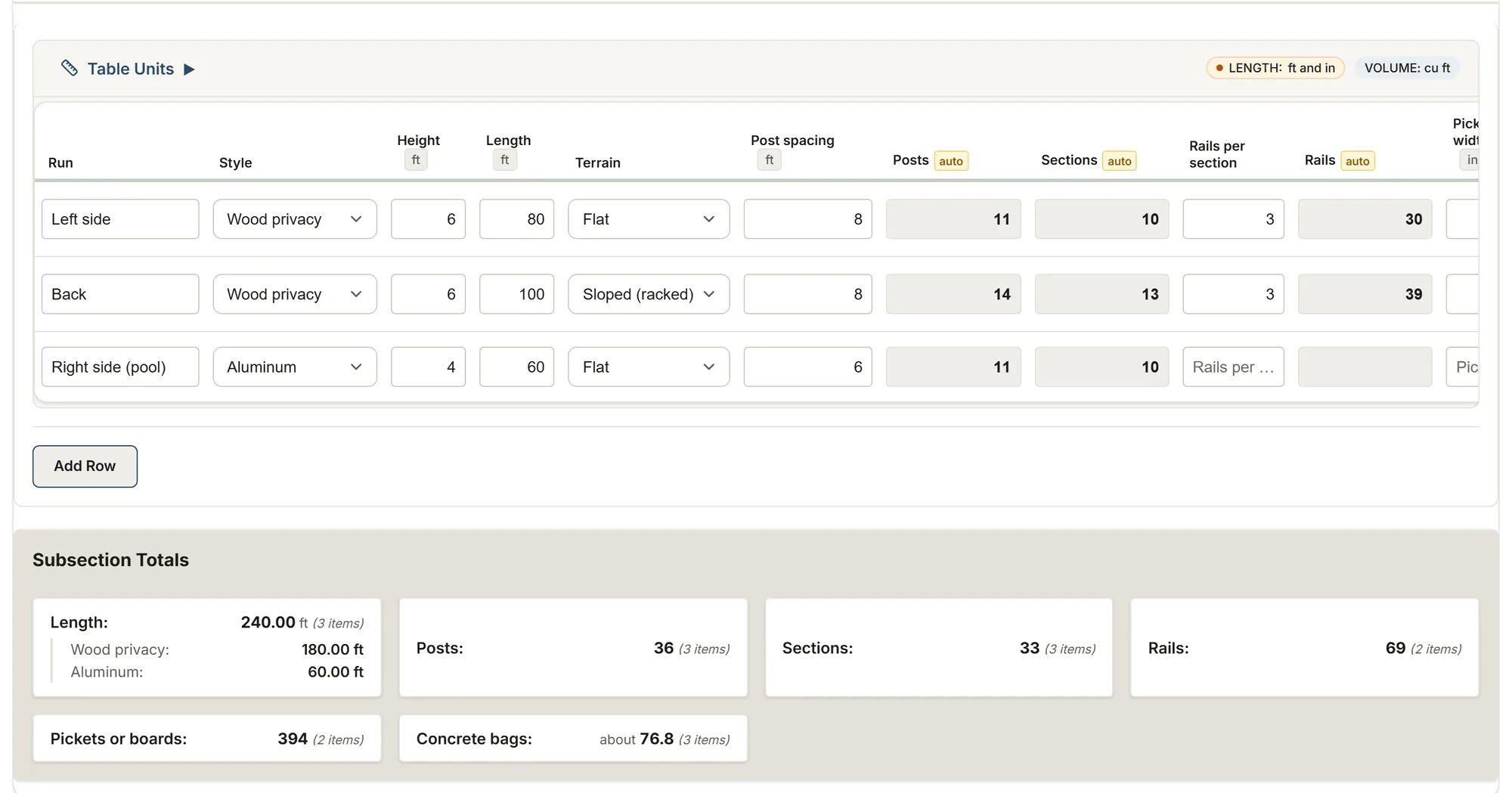
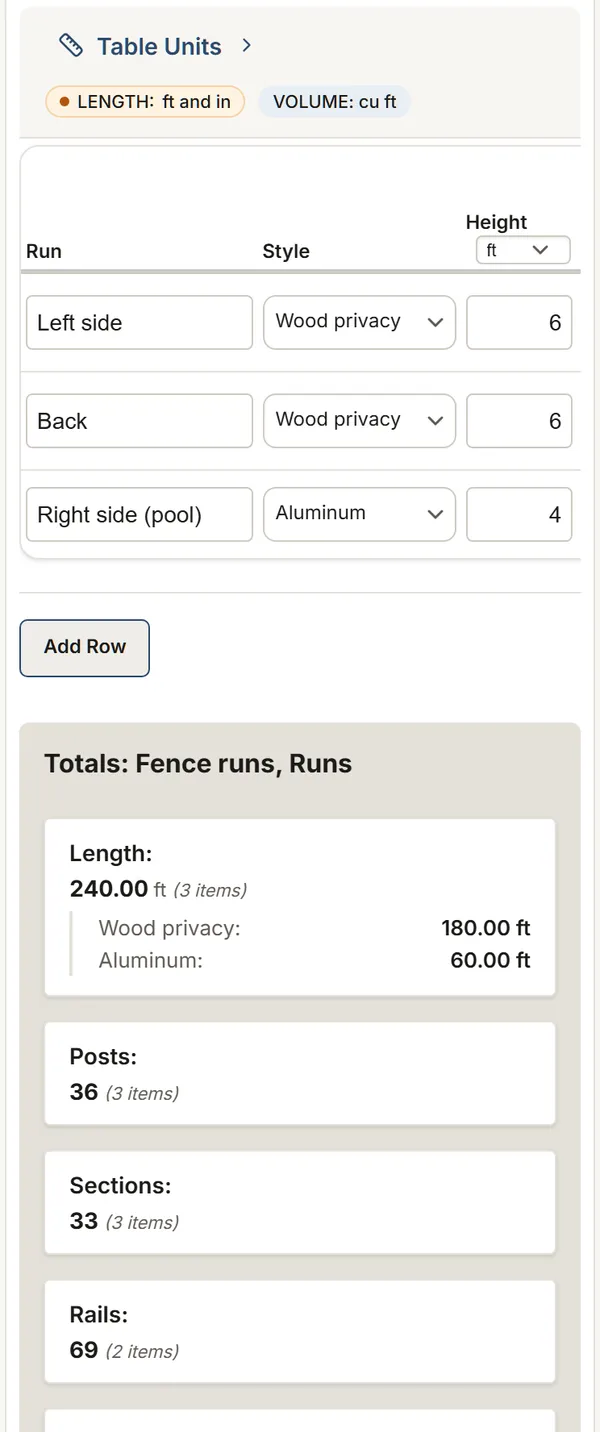
Walk the property on your phone: one row per fence run, with its style, height and length. MesuPro counts the posts, sections, rails and pickets from your spacing, and the concrete bags from the yield printed on the bag.
No credit card. Cancel anytime.
More templates to try: Fence repair: survey
Fencing templates
Feet, inches, square feet or metric: your choice.
Fence survey
Runs by style, posts, sections, rails and pickets, gates, concrete bags, the old fence and a chain link take-off.
You get: Posts Sections Rails
Fence repair: survey
Repairs: stretches, each post with its condition and the fix chosen, boards, rails and chain link to replace, sagging gates.
What you record on site
See the list (8)
- Each run: its style (wood, vinyl, chain link, aluminum, ornamental iron), height, length and terrain
- Your post spacing, the rails per section and the picket width
- The hole diameter, the post width and the concrete depth
- Gates: type, width, height, hardware and which way they open
- The old fence to remove and haul away
- For chain link: each straight stretch between two terminal posts, the fabric height, your spacing, your supplier's rail and roll lengths
- The property survey, the utility locate and the permit
- For a repair: each stretch to repair, each post with its condition, what it is set in and the fix chosen, the parts to replace and the gates that sag
What MesuPro calculates for you
See the list (7)
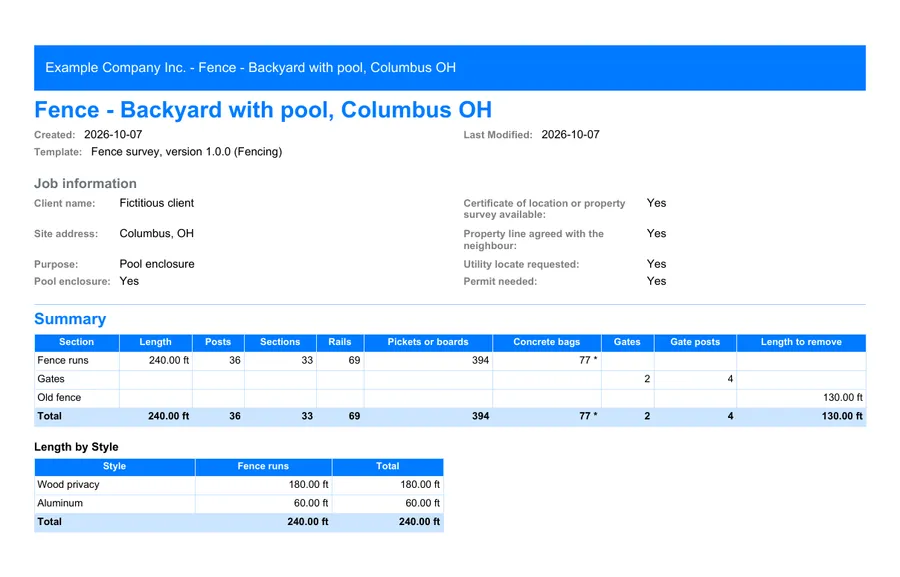
- The length by fence style
- Posts and sections for each run, from your spacing
- Rails and pickets
- Concrete per hole and the bags to buy, rounded up to the bag
- Gates and their posts, counted separately, and the gate frame to order from the maker's allowance
- For chain link: line posts, rails and rolls rounded up once, tension bars and bands, rail ends, ties and caps
- For a repair: the length by work asked, the posts by fix, the pieces and the length to replace by part
No spacing or yield comes filled in: they are yours and the bag's. For a pool enclosure, the template cites the ISPSC 2024 barrier rules; check the version your city adopts and its fence bylaw.
The report, as PDF or Excel
Export the survey to PDF with your photos for the client, or to Excel to bring the quantities into your quote.
FAQ
Does MesuPro know my spacing?
No: you enter your post spacing, rails and picket width. The template counts the rest.
What about a pool fence?
Check pool enclosure: the help cites the ISPSC 2024 barrier rules (at least 48 in, openings a 4 in ball cannot pass, gates opening outward that close and latch on their own). Check the version your city adopts.
What about chain link?
A table of its own, one straight stretch per row. In our Columbus example, the vegetable garden is closed by 40 ft and 25 ft of 4 ft fabric sharing a corner: at 10 ft spacing (Master Halco's maximum), 5 line posts and 3 terminal posts, 3.1 top rails of 21 ft (4 to buy), 1.3 rolls of 50 ft (2), 4 tension bars of 46 in and 53 ties.
How many bags of concrete?
From the hole diameter, the post width, the concrete depth and the yield printed on the bag. The total is rounded up to the bag.
What about a fence to repair?
Use the fence repair survey. In our Sioux Falls example, 24 ft of leaning fence is to be replaced in sections and 26 ft repaired in place; of the 4 posts noted, 2 rotted at the ground are replaced, 1 gets a mender and the corner heaved by frost a new footing.
Does the sheet say whether to repair or replace?
No: you choose the fix on each row. The hints cite Strong-Tie on bracing a leaning post, RONA and Wood Preservation Canada on setting a new post, and Hoover Fence on a gate's anti-sag cable, like the example's gate that has dropped 1 1/2 in.
Did this page help you?