For snow removal companies and their crews
Survey the site before the first snow, bid on real measurements.
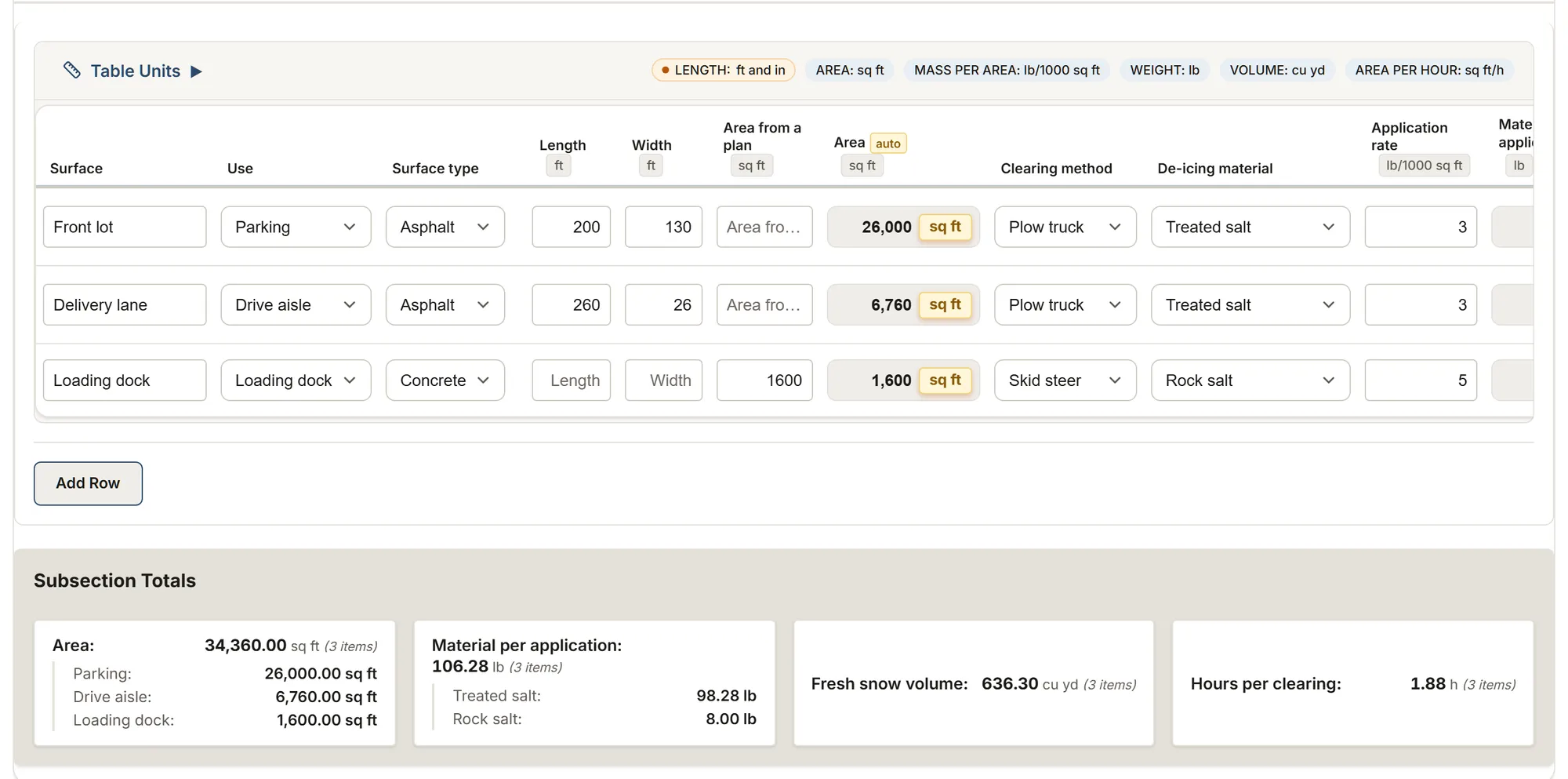
For snow removal companies and their crews: walk the lot, the walkways and the stairs on your phone. MesuPro calculates the areas by use, the de-icing material per application from your own rate, the stakes to install and how much snow your storage zones can take.
No credit card. Cancel anytime.
More templates to try: Residential snow removal survey
Snow removal templates, ready to use
Commercial lots or residential driveways.
Snow removal: site survey
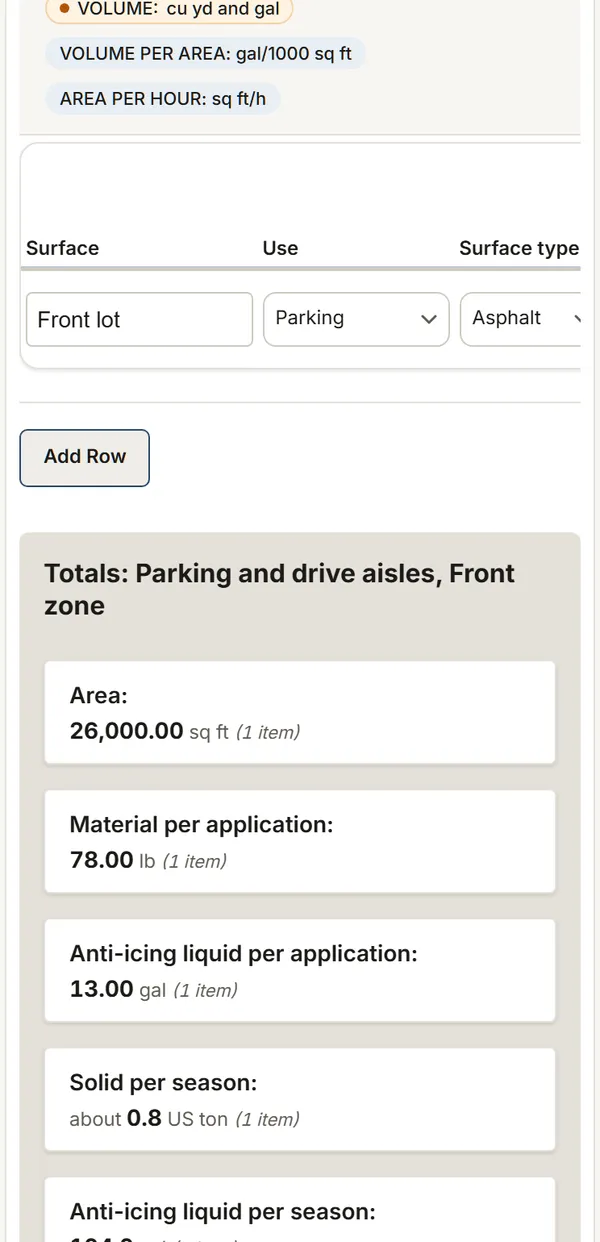
Areas by use, stairs and ramps, stakes, de-icing and liquids per application and per season at your rates, and room to pile snow.
You get: Area Material per application Pre-wet liquid per application
Residential snow removal survey
Driveway and cars, walkways, sidewalk, steps and balconies, stakes, snow piles and contract terms, with the hours per visit and for the season.
You get: Area Material per application Stakes
What you record on site
See the list (10)
- Each surface: its use (parking, drive aisle, loading dock, sidewalk, ramp), its surface, its length and width or the area from the plan
- The method (plow truck, loader, snowblower, shovel) and the de-icing material
- Liquids: pre-wetting the solid and anti-icing before the storm, with their rates, and your applications per season
- Stairs, ramps and docks done by hand
- Curbs, islands and drains to stake, and the obstacles: hydrants, light pole bases, speed bumps
- Snow storage zones, the height allowed and their distance from water and wells
- The client's contract terms: triggers, response time, level of service
- For a house: the driveway and the cars it holds, walkways, steps and balconies, and where the snow goes
- For a roof: each roof in plan, the snow measured and the snow to leave, the snow's weight, the access and the signs of overload
- For an ice dam: each stretch of eave with ice, how far it reaches up the slope, its thickness, the icicles, the gutter and downspout, the signs inside and the method planned
What MesuPro calculates for you
See the list (9)
- The area to clear of each surface, and the total by use
- De-icing material per application, from the rate you enter, by material
- The pre-wet and anti-icing liquid per application, then the season's solid in tons and liquids, per product
- The fresh snow volume for the storm depth you plan for, next to the volume of the storage zones
- The stakes to install along the edges
- Obstacles counted by type
- For a house: the hours per visit and for the season, from the visits you plan
- For a roof: the volume and weight of the snow to take off and the crew hours, never a verdict on what the roof carries
- For ice dams: the eave length and your hours, added up, never judging the cause
No rate comes filled in: the application rate depends on pavement temperature and stays yours. The template's guide cites a published parking lot table, Quebec's snow regulation and city rules. Your production rates and hours stay out of the report for the client.
The report, as PDF or Excel
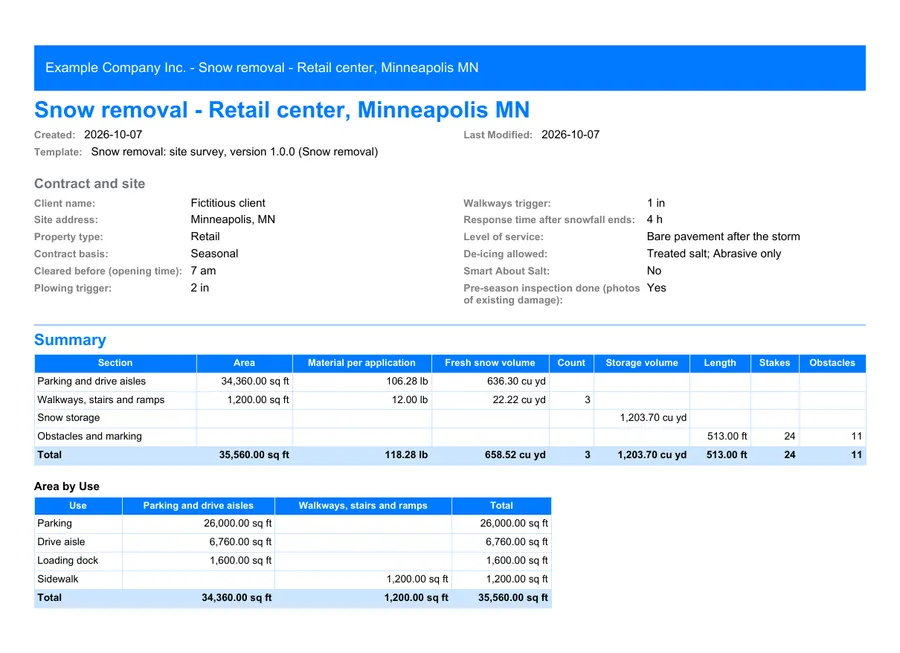
Export a PDF for the client with the areas, the stakes and the contract terms, without your production rates or hours, or the internal export with every column.
FAQ
Does MesuPro set my application rate?
No. The rate depends on pavement temperature and the snow: you enter it. The column's help cites a published parking lot table, from 3 to 8 lb per 1,000 sq ft depending on the temperature.
What about brine, for pre-wetting or anti-icing?
The site survey counts both. In our Minneapolis example, brine sprayed before the storm at 0.5 gal per 1,000 sq ft (UConn gives 0.5 to 0.75) comes to 13 gal on the 26,000 sq ft lot and 3.38 gal on the lane; at 8 anti-icing treatments a season, 132 gal to plan. At the dock, the 8 lb of rock salt pre-wet at 10 gal/ton take 0.04 gal a pass (the MPCA's common rate is 8 to 14 gallons/ton of brine, a starting point). The sheet switches between gallons and liters with the units. The rates and the counts are yours.
Where does the snow go?
The survey records the storage zones and their volume, next to the fresh snow volume of the areas you clear. Check your city's rules on where snow may go; in Quebec, snow kept on a lot stays away from watercourses, wetlands and wells.
Does it set the contract terms?
No. The triggers, the response time and the level of service are the client's: the contract form records them as given.
A house rather than a lot?
Use the residential snow removal template: the driveway and the cars it holds, walkways, steps and balconies, stakes and snow piles, with the hours per visit and for the season from the visits you plan.
What about roof snow removal?
Use the Roofs section of the residential survey. In our Buffalo example, the house roof is 1,320 sq ft in plan; with 18 in of snow and 2 in left (FEMA), 65 cu yd come off, about 33,400 lb at 19 lb/cu ft (about the NBC's 3.0 kN/m³ average on roofs), in 3.3 h at 400 sq ft an hour. The work is done from the ground with a roof rake (CNESST, OSHA). The sheet never judges what the roof can carry: that is an engineer's call.
What about ice dams?
Use the Ice dams table in the Roofs section. In our Buffalo example, 32 ft of the house's front eave hold ice, 3 ft up the slope and 4 in thick, with the gutter full of ice and a stain in an upstairs bedroom, and 12 ft at the garage: 44 ft in all, 4 h planned. The sheet does not judge the cause: NRCan points to warm attic air and advises air sealing and insulating. It also quotes its warning: an axe or an ice pick damages the roof.
Several lots on one site?
Click "Add a zone": each zone opens with its surfaces, edges and obstacles tabs, blank, and the sheet totals every zone.
Did this page help you?