Residential snow removal survey
Driveway and cars, walkways, sidewalk, steps and balconies, stakes, snow piles and contract terms, with the hours per visit and for the season.
No credit card. Cancel anytime.
Feet and inches or metric: your choice. One switch on the sheet converts every measurement.
What you measure
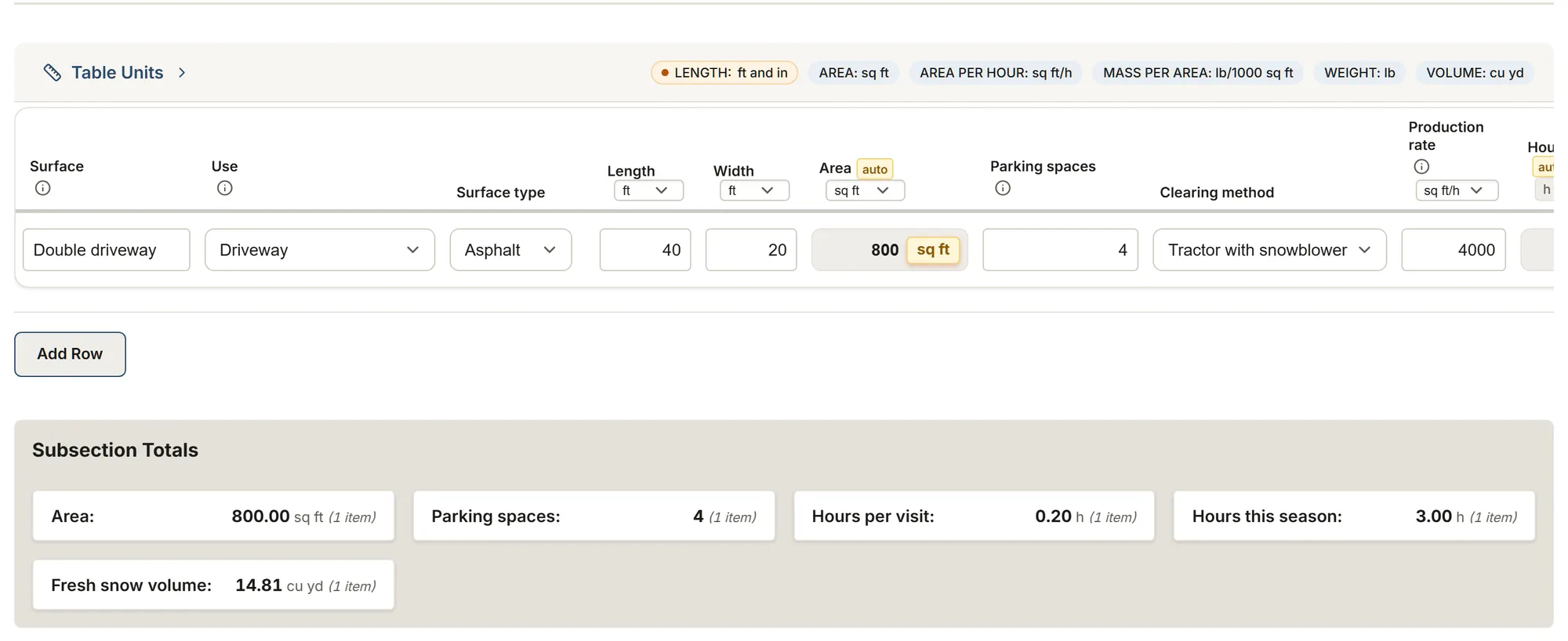
The template's tables and their columns, as the app shows them. Calculated columns fill in as you type.
Surfaces to clear
- Surface
- UseChoices: Driveway Extra parking spot Walkway City sidewalk Patio Path to the bins or shed Other
- Surface typeChoices: Asphalt Concrete Pavers Gravel Other
- Length
- Width
- Area calculated
- Parking spaces
- Clearing methodChoices: Plow truck Tractor with snowblower Snowblower Shovel
- Production rate
- Hours per visit calculated
- Visits this season
- Hours this season calculated
- De-icing materialChoices: None Rock salt Treated salt Abrasive (sand, grit) Salt and sand mix
- Application rate
- Material per application calculated
- Snow depth planned
- Fresh snow volume calculated
- Notes
Steps, balconies and landings
- ItemChoices: Front steps Back steps Balcony Landing Deck Ramp Other
- Width
- Number of steps
- Minutes per visit
- Hours per visit calculated
- Visits this season
- Hours this season calculated
- Notes
Edges to stake
- ItemChoices: Driveway edge Walkway edge Lawn edge Flower bed Curb Other
- Edge length
- Stake spacing
- Stakes calculated
- Notes
Obstacles to mark
- ItemChoices: Hydrant Mailbox Spot for the bins Garden border or low wall Shrub or hedge Lamp post Fence Well or septic cover Other
- Obstacles
- MarkedChoices: Yes To install Not needed
- Notes
Where the snow goes
- Spot
- OnChoices: Front lawn Beside the driveway Side yard Backyard Hauled away
- Length
- Width
- Maximum pile height
- Storage volume calculated
- Notes
Roofs
- Roof
- Kind of roofChoices: Sloped roof Flat or low-slope roof Temporary shelter Other
- Plan length
- Plan width
- Roof area in plan calculated
- Snow on the roof
- Snow to leave
- Snow weight per cu ft
- Snow to take off calculated
- Weight of the snow taken off calculated
- AccessChoices: From the ground with a roof rake From a lift with guardrails On the roof with fall protection To check
- Method and hazards
- Signs of overloadChoices: None seen Signs seen Not checked
- Roof clearing rate
- Roof clearing hours calculated
- Notes
About this template
Walk a house before the season: the driveway and the cars it holds, walkways, the city sidewalk, steps and balconies, the stakes and obstacles, where the snow goes, and the contract terms the client agrees to, with the hours per visit and for the season.
Guide and sources
Walk the property before the season with the client. One row per surface: the driveway and its extra spots, the walkway to the door, the city sidewalk when the contract includes it. The cars a driveway holds are counted with it.
Contract terms: the OPC (Quebec's consumer protection office) advises a written contract with fixed dates, a precise trigger (5 cm minimum rather than "a snowfall"), the time by which the snow is cleared, where it is piled, the related tasks such as salt or the access to the doors, and the price and payment terms. The sheet records them; your contract says the rest.
Time and visits: type your crew's rate for each method, or your minutes by hand for the steps and balconies; the sheet gives the hours per visit, and the hours for the season from the visits planned. For that number, the climate normals give the average days a year with snowfall at or above a trigger at each station (Environment and Climate Change Canada, NOAA in the US).
Stakes, obstacles and snow piles: city by-laws set the stakes (dates, distance from the curb), where the snow may go (never on the street, a sidewalk the city cleared or near a hydrant in many cities) and how high a pile may be at the street edge. Check your city's by-law; the hints quote Boucherville, Montréal and Minneapolis as examples. The client's report shows the surfaces, the cars, the methods and the de-icing; the rates, hours and visits stay in your team's report.
Roofs have a section of their own: one line per roof (the house, the garage, a shed, a temporary shelter). Its plan length and width, the snow measured on it and the snow to leave (FEMA: at least 2 in) give the snow to take off; the snow's weight per cubic foot, typed from the published ranges (FEMA: 3 to 21 lb for fresh snow; NBC: about 3.0 kN/m³ on roofs on average), gives its weight. Say how you reach it (CNESST: from the ground with a roof rake first) and whether the RBQ's signs of overload are there. The sheet never says what a roof can carry: removing snow is no reason to reduce design loads (NBC 4.1.6.14), and the structure is an engineer's call.
Sources
- Minneapolis, sidewalk snow clearing Government
- FEMA P-957 Government
- OSHA hazard alert 3513 Government
- NOAA NCEI, U.S. Climate Normals 1991-2020 Government
- TAC, salt on private roads and parking lots (2013) Trade association
- NBC 2020, 4.1.6 Code
- ECCC, Canadian Climate Normals 1991-2020 Government
- Boucherville, by-law 2026-480 Government
- Montréal, private snow removal permit Government
- CNESST, déneiger un toit Government
- RBQ, roofs (February 2025) Government
- OPC, before hiring a snow removal company Government
More templates: Snow removal
Snow removal: site survey
Areas by use, stairs and ramps, stakes, de-icing per application at your rate, and room to pile snow.
You get: Area Material per application Fresh snow volume
Your trade isn't listed? The AI assistant builds your form.
Start your 14-day free trialNo credit card. Cancel anytime.