How to measure a parking lot for snow removal
Before the first snow, walk the site: the surfaces to clear, the hand work, what to stake and where the snow goes. A worked example and a free calculator are waiting at the end.
What to bring
- A laser measure or a measuring wheel for large areas
- The site plan, if there is one: it often gives the area
- Stakes and something to mark the obstacles
- Your phone to record and photograph each zone in a MesuPro survey
Safety first: survey in daylight, outside busy hours, and stay visible in the lot. Photograph existing damage (curbs, lawn, pavement) before the season.
Step by step
Split the site by use
Parking, drive aisles, loading docks, sidewalks, ramps: each use calls for different equipment. Record each surface on its own row, with its length and width, or the area from the plan.
Note the hand work
Stairs, ramps, landings and entrances are cleared with a shovel or a snowblower: count them separately.
Stake before the first snow
Curbs, islands, catch basins, hydrants, light pole bases: what a plow can hit. Also note the spots that ice first: shade, poor drainage, drifting.
Choose where the snow goes
On the low side of the lot, so meltwater drains off the pavement toward a catch basin, away from watercourses and wells. Check your city's rules on where snow may go, and keep it off the street and the sidewalk.
Calculate salt from your rate
Salt per application = area x rate. The rate depends on pavement temperature and the snow: plow first, then apply the rate you set for those conditions.
The calculation
Area = length x width, added up for every surface. Salt per application = area x rate (lb per 1,000 sq ft, or kg per 100 m²). Salt for the season = salt per application x the applications planned. Fresh snow = area x storm depth, with no packing or melting. Storage zone = length x width x maximum pile height. No rate comes filled in: it is yours, by pavement temperature.
Worked example
On the fictitious site of the demo "Snow removal - Retail center, Minneapolis MN", the front lot of 200 ft by 130 ft and the delivery lane of 260 ft by 26 ft make 32,760 sq ft. At 3 lb per 1,000 sq ft, that is 98.3 lb of salt per application, and 1,966 lb for 20 applications in the season. A 6 in storm leaves 606.7 cu yd of fresh snow; the north zone of 65 ft by 50 ft, piled 8 ft high, holds 963 cu yd.
Common mistakes
- Forgetting the docks and ramps: small areas, a lot of work.
- Piling snow on the high side: meltwater refreezes on the pavement.
- Using the same rate at every temperature.
- Not photographing existing damage before the season.
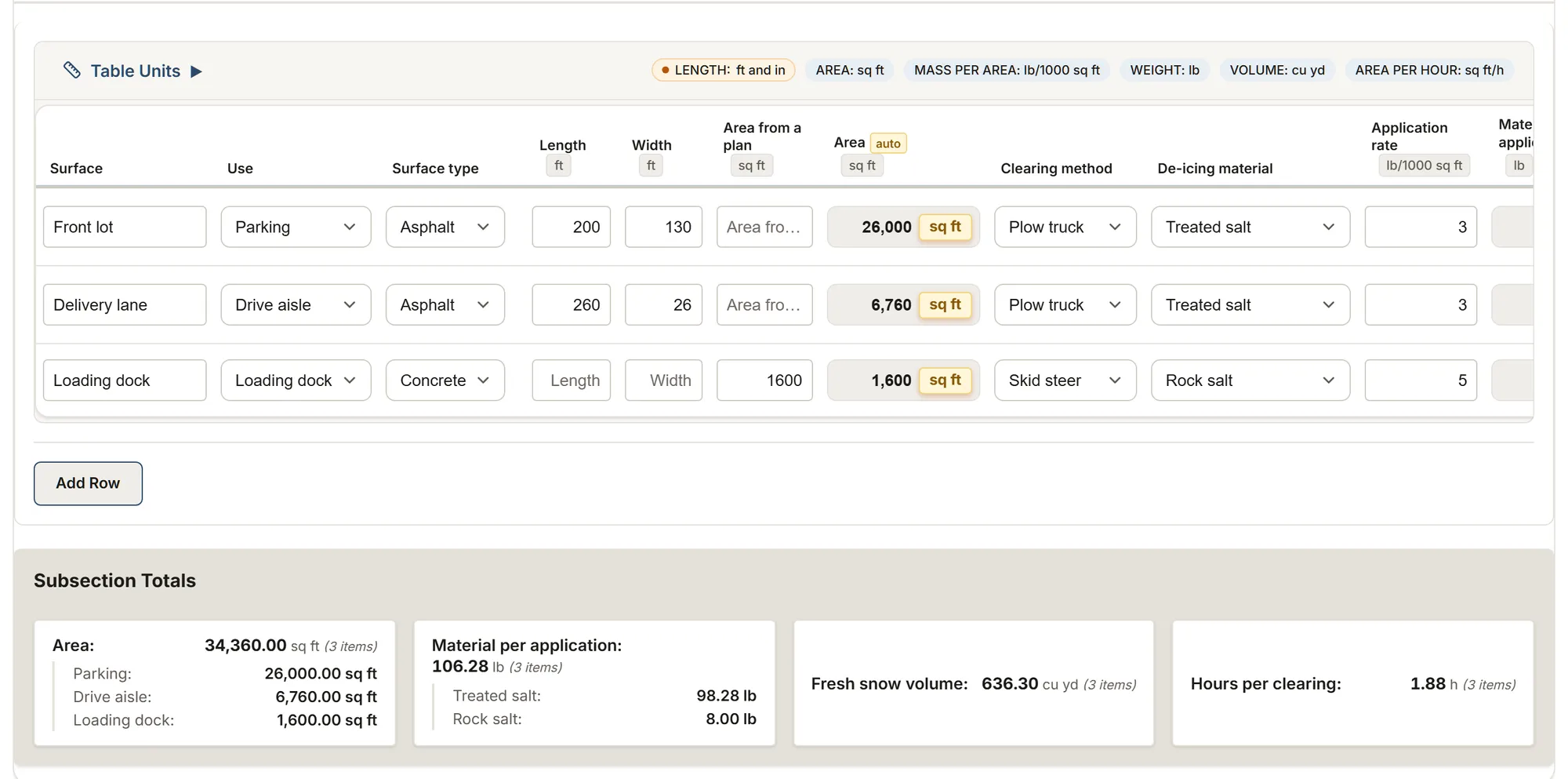
The whole job in MesuPro
Snow removal: site survey
Areas by use, stairs and ramps, stakes, de-icing per application at your rate, and room to pile snow.
Feet and inches by default
Start with this template Try it, no accountYour trade isn't listed? The AI assistant builds your form.
Start your 14-day free trialNo credit card. Cancel anytime.