Facade joint survey (ft)
Lengths in feet, joints in inches, volume in gallons and 10.1 oz cartridges, facade by facade.
No credit card. Cancel anytime.
Feet and inches or metric: your choice. One switch on the sheet converts every measurement.
What you measure
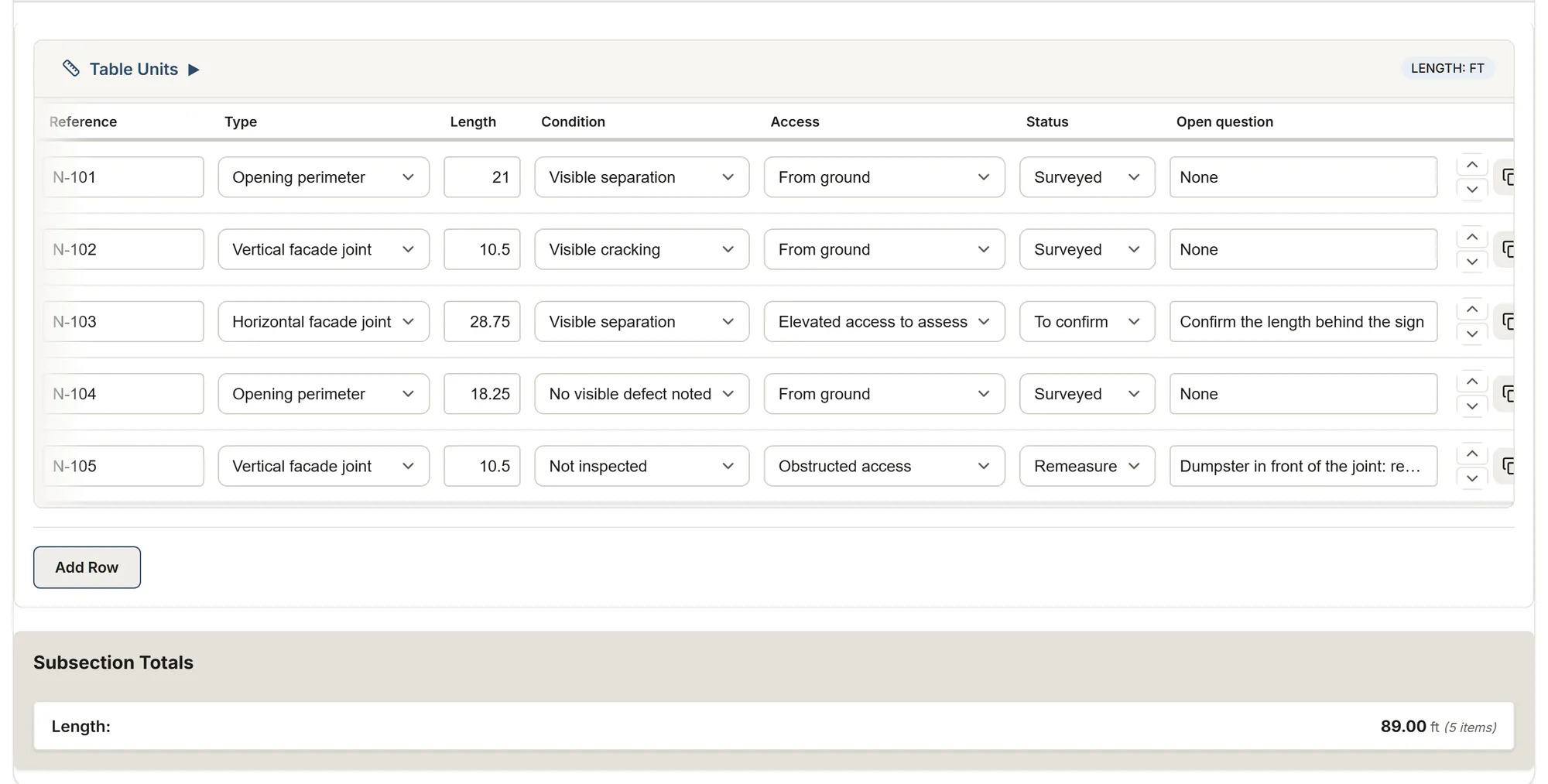
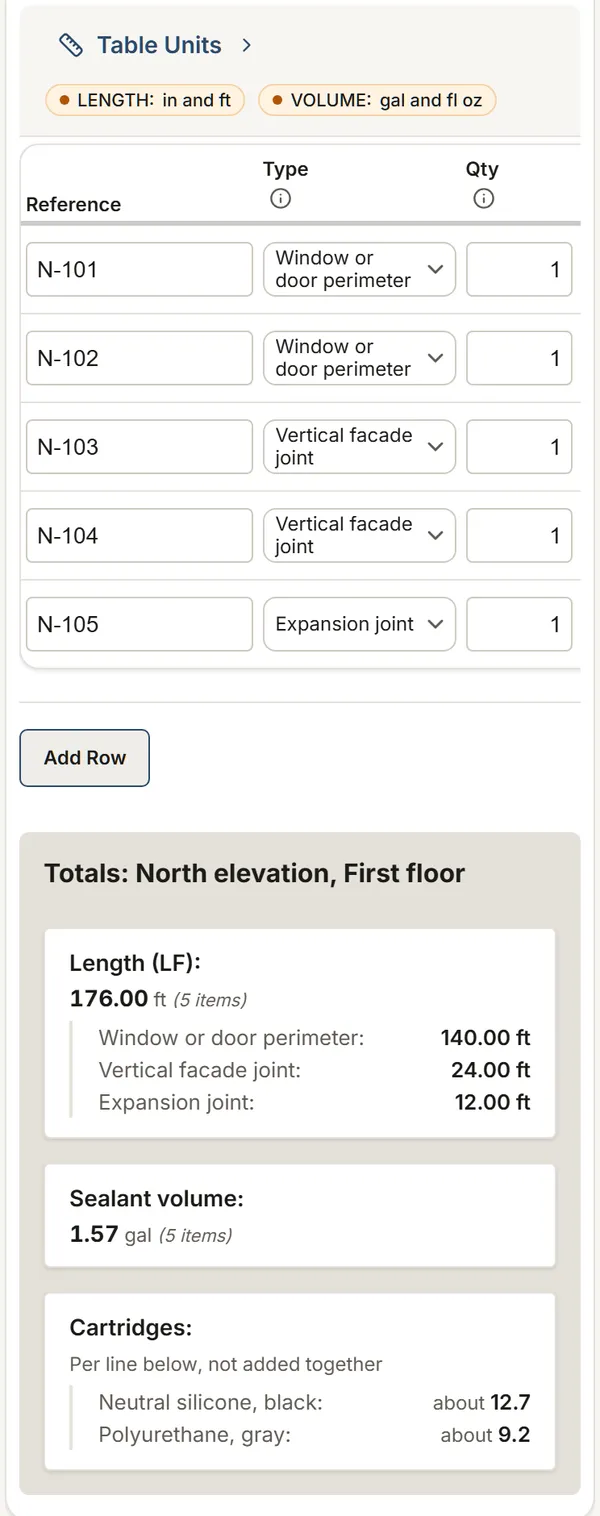
The template's tables and their columns, as the app shows them. Calculated columns fill in as you type.
Joint schedule
- Reference
- TypeChoices: Window or door perimeter Vertical facade joint Horizontal facade joint Other Control joint (masonry) Expansion joint Coping or parapet cap Penetration (louver, vent, conduit) Sill Sidewalk to building
- Qty
- Length (LF)
- Joint width
- Sealant depth
- Backer rod size
- Sealant volume calculated
- Waste
- Cartridge size
- Cartridges calculated
- Sealant (product)
- ConditionChoices: Visible separation Visible cracking No visible defect noted Not inspected Cohesive failure Missing or open joint Covered or patched over Hardened
- AccessChoices: From ground Elevated access to assess Obstructed Ladder Scissor lift Boom lift Swing stage Scaffold From the roof
- SubstrateChoices: Brick Precast concrete Cast-in-place concrete Concrete block Stone Aluminum (storefront, window) Metal panel Wood Vinyl EIFS (synthetic stucco) Other
- Existing sealantChoices: Polyurethane Silicone Polysulfide Acrylic Butyl Unknown
- Pull testChoices: Good adhesion Adhesive failure Cohesive failure Not tested
- Work to doChoices: Cut out and reseal Reseal over Spot repair No work Out of scope
- StatusChoices: Surveyed To confirm Remeasure
- Notes, open question
See these tables calculate with your own measurements, no account.
Try this templateMore templates: Caulking
Residential caulking survey
A house before a recaulk: windows and doors, other joints, bathroom and kitchen, cartridges from your product's coverage.
You get: Length to caulk Sides and top length Bottom length
Facade joint survey (m)
Lengths in meters, joints in millimeters, volume in liters and 300 ml cartridges, facade by facade.
You get: Sealant volume Cartridges
About this template
Joint survey for resealing: lengths, widths, condition, access and sealant quantities
Guide and sources
Read the guide and sources
Walk each facade floor by floor, one row per joint type and detail. Type the total length of the joints the row covers: the count is for the record only.
Measure the joint width. The sealant depth is about half the width for joints of 1/2 to 1 in (13 to 25 mm), equal to the width below that, between 1/4 and 1/2 in (6 to 13 mm). Pick a backer rod 25 to 50% wider than the joint; where the joint is too shallow for a rod, use bond-breaker tape.
Cartridges come from width x depth x length plus the waste you type (Tremco's calculators: 10 to 15% for an average applicator; more on porous masonry), over the cartridge size on the sealant's data sheet, filled in at Tremco's 10.1 fl oz (300 mL).
Note the failure you see: adhesive (the sealant pulled off the edge), cohesive (it tore in the middle), the edge itself broken, or a hardened, cracked sealant. In a pull test, a cohesive tear is a pass. Remove the old sealant before resealing; sealing over it is acceptable only after a mock-up and a pull test.
Caulk put in from 1950 to 1980, of any type, may contain PCBs: have it tested before removal and record it in the site form.
Sources
- ASTM C920 paywalled Standard
- UFGS 07 92 00 Government
- Sika, Sikaflex-1a Manufacturer data
- Tremco, Dymonic 100 Manufacturer data
- Pecora, Dynatrol II Manufacturer data
- MasterSeal NP 1 Manufacturer data
- ASTM C1193 paywalled Standard
- Tremco, sealant calculators Manufacturer data
- EPA, PCBs in caulk Government
- EPA-530-R-23-015 Government
- ASTM C1521 paywalled Standard
- Pecora TB 55 Manufacturer data
- NMS 07 92 00 Government
- Adfast, fiche 1940 Manufacturer data
- Würth, sealant calculator Manufacturer data
- SOR/2008-273 (PCB) Government
Your trade isn't listed? The AI assistant builds your form.
No credit card. Cancel anytime.