Residential caulking survey
A house before a recaulk: windows and doors, other joints, bathroom and kitchen, cartridges from your product's coverage.
No credit card. Cancel anytime.
Feet and inches or metric: your choice. One switch on the sheet converts every measurement.
What you measure
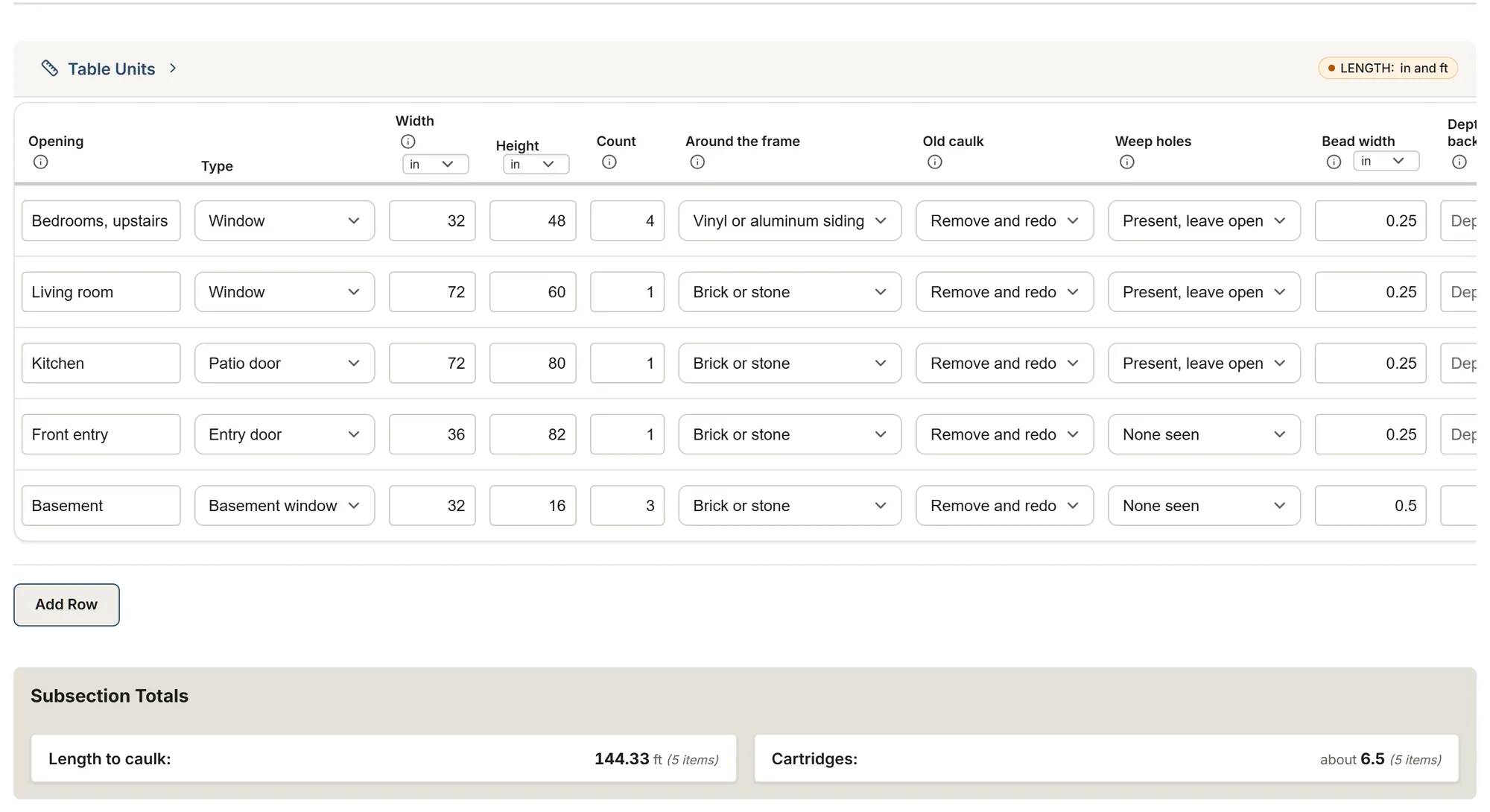
The template's tables and their columns, as the app shows them. Calculated columns fill in as you type.
Windows and doors
- Opening
- TypeChoices: Window Basement window Patio door Entry door Garage door Other
- Width
- Height
- Count
- Around the frameChoices: Brick or stone Vinyl or aluminum siding Wood or fibre cement Stucco Trim Drywall or plaster Other
- Old caulkChoices: Remove and redo No old caulk Spot repair
- Weep holesChoices: Present, leave open None seen
- Bead width
- Depth over a backer rod
- Sealant
- Length per cartridge, maker
- At a bead of
- Waste
- Length to caulk calculated
- Length per cartridge, this bead calculated
- Cartridges calculated
- Notes
Other joints
- Location
- JointChoices: Wall on the foundation Corner or trim board Two claddings meet Penetration (vent, pipe, wire) Baseboard or casing Other
- Length each
- Count
- Around the frameChoices: Brick or stone Vinyl or aluminum siding Wood or fibre cement Stucco Trim Drywall or plaster Other
- Old caulkChoices: Remove and redo No old caulk Spot repair
- Bead width
- Depth over a backer rod
- Sealant
- Length per cartridge, maker
- At a bead of
- Waste
- Length to caulk calculated
- Length per cartridge, this bead calculated
- Cartridges calculated
- Notes
Bathroom and kitchen joints
- Location
- JointChoices: Tub to wall Shower base or curb Shower door or glass panel Sink or vanity Backsplash to counter Counter to wall Toilet base Other
- Length each
- Count
- Old caulkChoices: Remove and redo No old caulk Spot repair
- Bead width
- Depth over a backer rod
- Sealant
- Length per cartridge, maker
- At a bead of
- Waste
- Length to caulk calculated
- Length per cartridge, this bead calculated
- Cartridges calculated
- Notes
Weatherstripping
- Door, window or hatch
- OpeningChoices: Entry door Patio door Garage door Operable window Attic hatch Other
- Width
- Height
- Count
- Edges to sealChoices: Sides and top All four sides Bottom only
- Sides and top length calculated
- Bottom length calculated
- Weatherstrip kindChoices: Foam or rubber (compression) V-strip (tension) Spring-loaded or magnetic Door sweep Door bottom Threshold seal Garage door seal
- Gap to close
- Weatherstrip product
- Length per roll or kit
- Weatherstrip waste
- Rolls or kits calculated
- Notes
About this template
Measure a house before quoting a recaulk: each window and door, the other joints and the bathroom and kitchen joints, the old caulk to remove and the weep holes to keep open. The length to caulk, and the cartridges from your product's own coverage brought to the bead you apply.
Guide and sources
One row per window or door, or per group of identical ones with their count: measure the outside of the frame or trim, where the bead runs, and the sheet gives the perimeter to caulk. The other joints (the walls on the foundation, corners and trim, two claddings that meet, penetrations) and the bathroom and kitchen joints are measured as lengths. Note the old caulk to remove, and the weep holes at the bottom of a window, which stay open.
Each section takes one product: type it once at the top of the section, with the length one cartridge lays and the bead size the maker prints next to it, the bead you will apply and your waste. Rows start from those fields and each row can change them. Makers print their coverage for a round bead (DAP: 55 ft per 10.1 oz cartridge at 3/16 in), so the sheet brings that length to your bead: twice as wide lays a quarter of the length. Over a backer rod, type the depth: the joint then holds width x depth. A gap of 1/4 in (6 mm) or more takes a backer rod first (NRCan, ENERGY STAR).
The cartridges are added up per product and rounded up once in the totals. Before booking the work, check the product's data sheet: DAP asks above 4.4 °C (40 °F) with no rain or frost within 24 hours; in a bathroom, the time before water goes from 2 hours (LePage 2in1) to 12 hours (GE Tub & Tile). The client's report shows the openings, the joints and the lengths to caulk; the products' coverage and the cartridges stay in your team's report.
Weatherstripping has a section of its own, one row per door, window or hatch: its width and height and the identical count, then the edges to seal. Sides and top give the jamb-and-head length, the bottom the sweep, door bottom or threshold length, all four sides both (an attic hatch). NRCan's Table 3-4 sorts the products by where they work; a door bottom needs 8 to 13 mm (1/3 to 1/2 in) under the door. Type the length per roll or kit from the package and your waste, and the sheet gives the rolls or kits, rounded up once per product.
Sources
- EPA, asbestos in window caulk Government
- EPA, lead RRP rule Government
- Ply Gem, window installation Manufacturer data
- ENERGY STAR, window and door trim Government
- DAP, Dynaflex 230 Manufacturer data
- GE, Tub & Tile Silicone 1 Manufacturer data
- Tremco, sealant calculators Manufacturer data
- ENERGY STAR, attic hatch Government
- NBC 2020, 9.27.4.1 Code
- GE, Advanced Silicone 2 Manufacturer data
- Mulco, kitchen and bathroom silicone Manufacturer data
- Health Canada, asbestos Government
- NRCan, Keeping the Heat In Government
- DAP, Alex Ultra Manufacturer data
- LePage, 2in1 kitchen and bath Manufacturer data
- NRCan, weatherstripping (Table 3-4) Government
- Québec, air leaks Government
More templates: Caulking
Facade joint survey (ft)
Lengths in feet, joints in inches, volume in gallons and 10.1 oz cartridges, facade by facade.
You get: Sealant volume Cartridges
Facade joint survey (m)
Lengths in meters, joints in millimeters, volume in liters and 300 ml cartridges, facade by facade.
You get: Sealant volume Cartridges
Your trade isn't listed? The AI assistant builds your form.
Start your 14-day free trialNo credit card. Cancel anytime.