How to measure windows for blinds
A custom blind is ordered at the size its maker asks for, and that size changes with the mount: inside the window frame or over it. Here is what to measure, where, and what the maker does with your numbers. A worked example and a free calculator are at the end.
What to bring
- A steel tape measure, not a cloth one, read to the nearest 1/8 in
- A step ladder
- Your phone to record and photograph each window in a MesuPro survey
- The measuring guide or order form of the chosen product's maker
Where children live or visit, choose a control without a reachable cord: the Best for Kids label of the Window Covering Safety Council marks products without operating cords, or with cords out of reach; in Canada, regulation SOR/2019-97 limits any reachable cord of an indoor window covering to 22 cm.
Step by step
Choose the mount before you measure
Inside mount: the blind sits in the window frame. Outside mount: it covers the trim, or mounts on the wall or the ceiling. A window too shallow, out of square or blocked by a crank or a handle may call for an outside mount (Hunter Douglas Canada, Levolor).
Measure three widths
To the nearest 1/8 in, with a steel tape: inside the frame at the top, in the middle and at the bottom (a roller shade at the top only, at Bali). Inside mount, keep the narrowest; outside mount, the widest, plus the overlap on each side the maker asks for.
Measure three heights
At left, centre and right, from the top of the opening to the sill. Inside mount, the maker says which one to keep: the longest for most shades and horizontal blinds, the shortest for vertical blinds, sliding panels and shutters. Outside mount, the longest, plus the room above for the brackets and the room below.
Take nothing off
Write the readings as they are: for an inside mount, the maker takes off what the blind needs to fit the frame (Bali, Levolor, Norman, Maxxmar).
Measure the depth
Inside the frame at the top, in three places, and keep the shallowest: a crank, a handle or a latch counts. Compare it with the product's minimum depth on its chart: 1/2 to 3 in by product at Levolor.
Check the diagonals
Corner to corner, both ways: diagonals that differ mean the window is not square. For shutters, Hunter Douglas Hospitality goes to an outside mount past 3/8 in apart.
The calculation
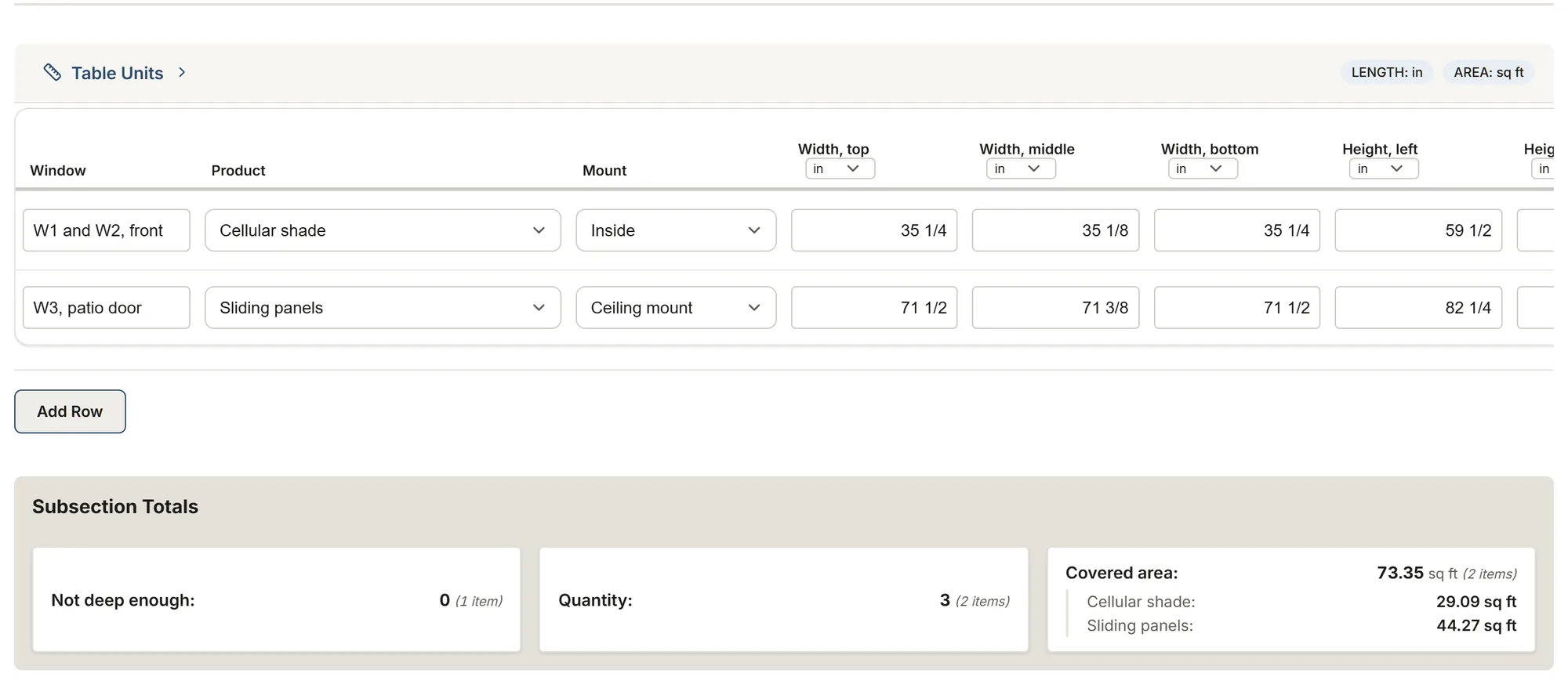
Inside mount: width for the order = the narrowest width measured; height = the longest height, or the shortest when the maker asks for it (vertical blinds, sliding panels, shutters). No deduction: the maker takes it for an inside mount. Outside mount (on the trim, the wall or the ceiling): width = the widest width + 2 x the overlap per side; height = the longest height + the room above + the room below. A reading left empty is not counted; an overlap or a room left empty counts 0. Covered area = width x height / 144 x quantity, in sq ft. Not deep enough: an inside mount whose depth available is under the product's minimum depth, x the quantity. The same formulas as the window coverings measure template; the sizes show to the nearest 1/8 in.
Worked example
In a fictitious house, Bali cellular shades throughout. In the living room, two identical windows, inside mount: widths of 35 1/4, 35 1/8 and 35 1/4 in (35.25, 35.125 and 35.25 in the calculator), heights of 59 1/2, 59 5/8 and 59 1/2 in (59.5, 59.625 and 59.5) and 2 in of depth. In the kitchen, an inside mount window of 24, 24 1/8 and 24 in (24.125) by 36, 36 and 35 7/8 in (35.875), where the crank leaves only 1 1/4 in of depth (1.25). In the bedroom, an outside mount on the trim: 30, 30 1/8 and 30 in (30.125) by 48, 48 1/4 and 48 in (48.25). Bali recommends 1 1/2 in on each side (1.5) for an outside mount and asks for 2 in of flat surface above, and keeps the longest height inside; its minimum depth runs from 5/8 to 1 3/8 in by shade, and this example takes 1 3/8 in (1.375). With no deduction at all, the calculation gives 35 1/8 x 59 5/8 in for the living room, 24 x 36 in for the kitchen and 33 1/8 x 50 1/4 in for the bedroom. 1 inside mount is not deep enough, the kitchen one: to review before ordering, an outside mount for one. In all, 4 blinds and 46.6 sq ft of fabric.
Common mistakes
- Taking a deduction yourself on an inside mount: the maker takes one too, and the blind ends up too narrow.
- Measuring with a cloth tape, or rounding to the inch.
- Keeping the longest height for a vertical blind or shutters when the maker asks for the shortest.
- Forgetting the crank or the handle in the depth.
- Applying one maker's overlap to another maker's product.
The whole job in MesuPro
Window coverings: window measure
Windows room by room: three widths and heights, mount, depth, diagonals, control, the size for the order and curtains.
You get: Covered area
Your trade isn't listed? The AI assistant builds your form.
Start your 14-day free trialNo credit card. Cancel anytime.