How to measure a floor for an epoxy coating
Before you bid an epoxy floor, record each area, what stays uncoated, the walls that get a cove base and the state of the slab. A worked example and a free calculator are waiting at the end.
What to bring
- A tape measure or a laser measure
- The data sheets of the planned products (primer, body coat, topcoat, flakes)
- The moisture test kit the data sheet asks for
- Your phone to record and photograph each area in a MesuPro survey
Step by step
Measure each area
The length and width at the floor, wall to wall. Split an L-shaped room into rectangles: one row each. Record each area apart (garage, shop, mechanical room): they do not always get the same system.
Note what stays uncoated
An equipment pad, a pit, a drain or a column base: their area is a deduction on the row of the area around them.
Record the cove base
The walls where the coating runs up in a cove: their length without the doors, and the planned height (often 4 or 6 in). The cove is coated like the floor and built with its own kit.
Check the slab before the numbers
The moisture by the test the data sheet asks for (calcium chloride ASTM F1869, relative humidity probes ASTM F2170, plastic sheet ASTM D4263), the surface profile it requires (ICRI CSP, by grinding or shot blasting), the cracks and the age of the concrete. Record the results in the survey: they decide the system, not only the quantity.
Read the data sheet of each product
The dry film per coat, the volume solids and the kit size. Theoretical coverage = 1,604 x volume solids / 100 / dry film in mils: compare it with the coverage the sheet prints. Then the flake broadcast rate and the box size, if any.
The calculation
Floor area = length x width - deduction, added up over every row (never below 0). Cove area = cove length x cove height. Area to coat = floor + cove. Coverage per gallon = 1,604 x volume solids / 100 / dry film per coat in mils: a US gallon is 231 cu in, and spread 1 mil (0.001 in) thick it covers 1,604 sq ft; in metric, 1 L at 1 µm covers 1,000 m², so m²/L = 10 x volume solids / dry film in µm. Liquid = area to coat x coats / coverage x (1 + loss). Kits = liquid / kit size, rounded up to the kit. Flakes = floor area x broadcast rate, boxes rounded up to the box. Cove kits = cove length / the kit's printed yield, rounded up. The coverage is the theoretical one: porous or rough concrete takes more, which is what the loss is for. Every figure comes from your product's data sheet: nothing is filled in.
Worked example
In a fictitious two-car garage of 24 x 22 ft with a 12 x 10 ft shop where a 6 sq ft equipment pad stays uncoated, the body coat of a 100% solids epoxy at 8 mils (its data sheet prints 200 sq ft per gallon at 8 mils), in 1 coat with 10% loss and 3 gallon kits, makes 642 sq ft to coat, a coverage of 200.52 sq ft per gallon, 3.52 gallons and 2 kits. Flakes of 1/4 in broadcast at 12 lb per 100 sq ft in 55 lb boxes: 77 lb, 2 boxes.
Common mistakes
- Taking solids by weight for solids by volume: the coverage works with volume solids.
- Taking the wet film for the dry film: for a water-borne or solvent-borne product, dry film = wet film x volume solids.
- Adding the primer, the body coat and the topcoat into one kit count.
- Forgetting the cove base, or the loss on porous or freshly ground concrete.
- Rounding the kits area by area instead of on the total.
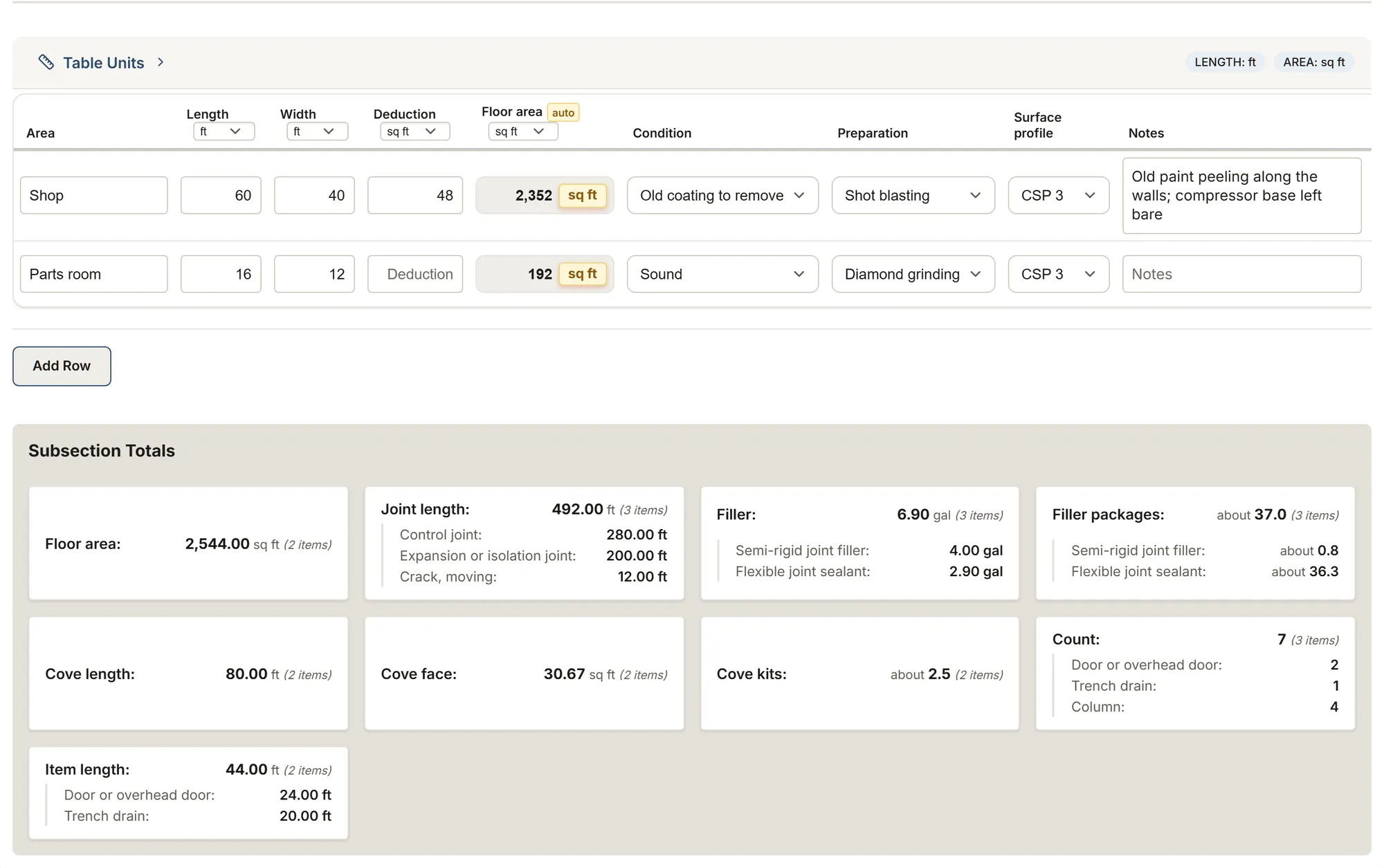
The whole job in MesuPro
Epoxy floor survey
Floor areas, joints and cracks, moisture tests, cove base, doors and drains; each coat's coverage, liquid, kits, flakes and quartz.
You get: Floor area Filler Filler packages
Your trade isn't listed? The AI assistant builds your form.
Start your 14-day free trialNo credit card. Cancel anytime.