Yard drainage survey
French drains and dry wells: trench, stone, geotextile, water to hold, pit volume and footprint, hours to empty.
No credit card. Cancel anytime.
Feet and inches or metric: your choice. One switch on the sheet converts every measurement.
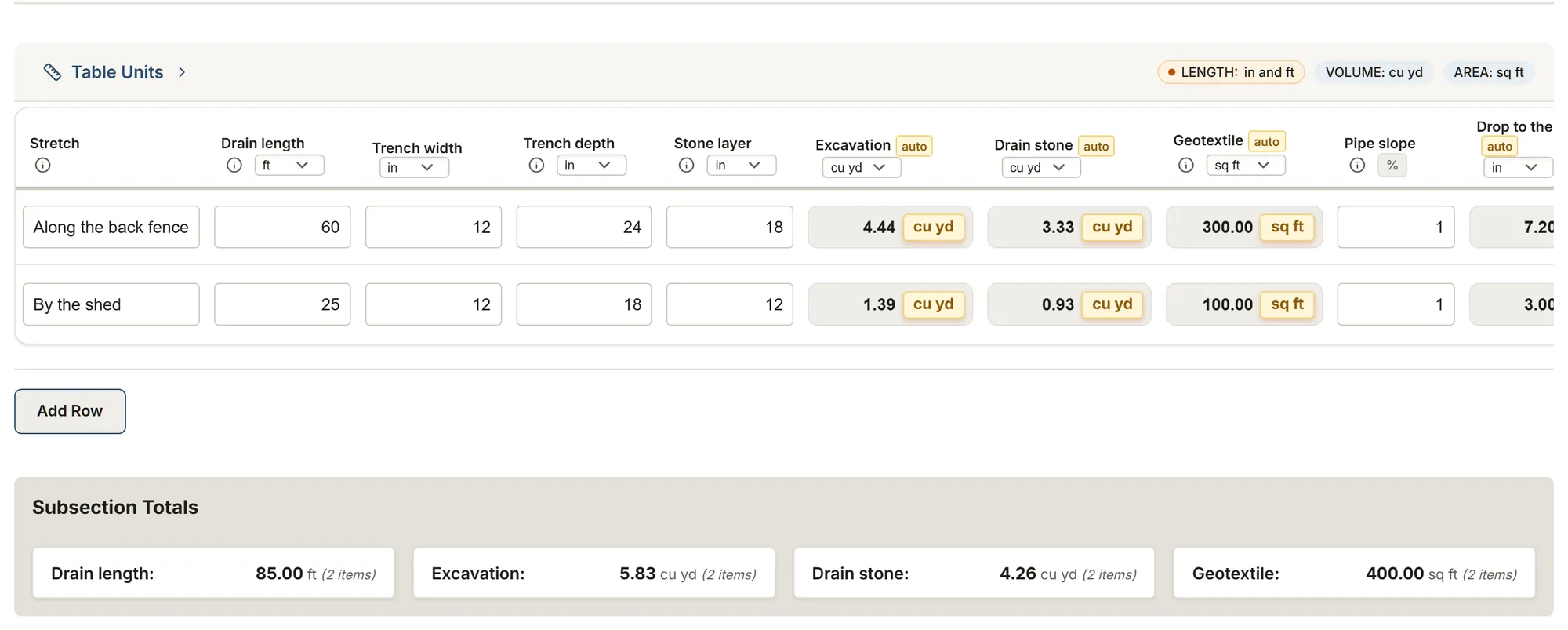
What you measure
The template's tables and their columns, as the app shows them. Calculated columns fill in as you type.
French drains
- Stretch
- Drain length
- Trench width
- Trench depth
- Stone layer
- Excavation calculated
- Drain stone calculated
- Geotextile calculated
- Pipe slope
- Drop to the outlet calculated
- OutletChoices: To daylight To a dry well To the street storm sewer Other
- Notes
Dry wells
- Dry well
- Area drained
- Design rain
- Water to hold calculated
- Stone voids
- Pit volume calculated
- Pit depth
- Pit footprint calculated
- Soil infiltration
- Hours to empty calculated
- Distance to the foundation
- Notes
About this template
French drains and dry wells for a wet yard: each trench's excavation, stone, geotextile and drop to its outlet; each dry well's water to hold from the area it drains and your design rain, its pit over the stone's voids, its footprint and the hours the soil takes to empty it.
Guide and sources
Walk the wet spots with the client: one row per stretch of french drain, with its length, the trench's width and depth and the stone layer; one row per dry well, with the roof or yard area that drains to it. The sheet gives the excavation, the stone and the geotextile for each trench, the drop to its outlet for the slope you choose, and for each well the water it must hold and the pit that holds it.
A dry well holds a design rain over the area it drains: the Quebec guide stores 5 to 25 mm (0.2 to 1 in) of rain from the roof, New Hampshire's homeowner guide a 1-inch storm. The stone leaves 35 to 40 % of the pit to water (Quebec guide; 30 to 40 % for CVC and TRCA), so the pit is the water over its voids; spread over the depth you choose, that is its footprint. Keep it at most about 1.5 m (5 ft) deep, its bottom 1 m above the water table or rock, and 4 m (13 ft) from any foundation.
Test the soil where the pit goes (New Hampshire: fill a hole twice, read the drop in 15 minutes, multiply by 4): the sheet then gives the hours the full pit takes to empty, to compare with the 48 hours the Quebec guide and CVC design for. Below 15 mm/h (0.6 in/h), a loam, the Quebec guide says no infiltration pit. Request a locate before digging and ask the municipality where the water may go. The client's report shows the drains and wells and their size; the stone, geotextile and design figures stay in your team's report.
Sources
- ADS, product catalog Manufacturer data
- Oregon State Extension, drywells Trade association
- IRC 2021, R401.3 Code
- New Hampshire homeowner's guide, dry well Government
- 811 (US) Trade association
- NBC 2020, 9.12.4.1 Code
- CVC and TRCA, LID guide (soakaways) Government
- Quebec stormwater guide Government
- Info-Excavation Trade association
More templates: Landscaping
Hardscaping: patios & walkways
Patios, walkways and walls: material with waste, base stone in tons, polymeric sand, geotextile and excavation.
You get: Total area Material to order Base volume
Landscaping: planting
Beds, hedges and amendments: number of plants, mulch and soil volumes.
You get: Planting area Total number of plants Mulch needed
Lawn installation: sod and seed
A new lawn, zone by zone: sod or seed, sod to order, rolls, pallets, seed, topsoil and fertilizer.
You get: Lawn area Sod to order Seed to buy
All about the trade: Landscaping
Dry well calculator: free, no account
Your trade isn't listed? The AI assistant builds your form.
Start your 14-day free trialNo credit card. Cancel anytime.