Concrete block wall: survey
Wall by wall: net area, blocks from the size and joint with waste, mortar bags, grouted cores and grout bags, per product.
No credit card. Cancel anytime.
Feet and inches or metric: your choice. One switch on the sheet converts every measurement.
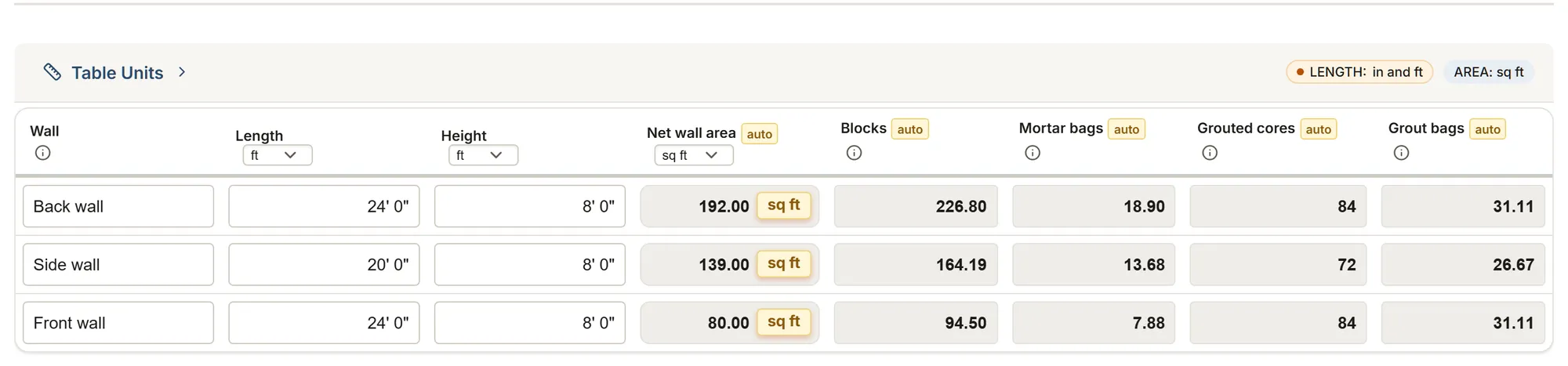
What you measure
The template's tables and their columns, as the app shows them. Calculated columns fill in as you type.
Block walls
- Wall
- Length
- Height
- Openings
- Net wall area calculated
- Block
- Block length
- Block height
- Joint
- Waste
- Blocks calculated
- Mortar typeChoices: Type S Type N
- Mortar
- Blocks per bag
- Mortar bags calculated
- Grout spacing
- Grouted cores calculated
- Grout
- Cores per bag
- Grout bags calculated
- Notes
About this template
Wall by wall: the net area, the blocks from their size and joint with the waste, the mortar bags at the blocks a bag lays, and the grouted cores from the spacing with the grout bags, per product, rounded up once.
Guide and sources
One row per wall: its length and height and the openings to take out, then the block you lay. Type the block's actual size and the joint (NBC 9.20.4: 10 mm, 3/8 in): the face it covers gives the units, with TEK 04-02A's 5% for waste (119 blocks of 8 x 16 in per 100 sq ft). Pilaster, corner and bond beam units are counted on their own rows.
The mortar: type the blocks a bag lays, from the bag (Sakrete type S and Sable Marco premix: about 12 per 30 kg bag) or the TEK (about 30 per 70 lb bag of masonry cement with sand). The grout: type the spacing from the plans and the cores a bag fills (TEK Table 4: 2.7 for an 8 in block per 80 lb bag); the sheet counts the cores along the wall times the courses. Blocks, mortar and grout add up per product and round up once.
Recorded, never a design: the reinforcement and the grout spacing are the plans' or the engineer's; the NBC asks type S mortar for loadbearing and foundation walls. The client's report shows the walls, the areas, the blocks and the bags; the sizes, the waste, the per-bag yields and the cores stay in your team's report.
Sources
- CMHA, TEK 04-02A Trade association
- NBC 2020, 9.20.4.1 Code
- NBC 2020, 9.20.3.2 Code
- Sakrete, type S mortar Manufacturer data
- Sable Marco, mortar Manufacturer data
More templates: Masonry
Masonry repair survey
Elevations, repointing by the square foot and by the linear foot of joint, mortar bags, bricks, cracks, lintels and sills, chimneys and parging.
You get: Joint length Mortar Mortar bags
Your trade isn't listed? The AI assistant builds your form.
Start your 14-day free trialNo credit card. Cancel anytime.