Commercial shades: schedule by floor
For commercial jobs: shades by floor and zone, pocket or fascia, fabric and openness, control groups, cubicle curtains.
No credit card. Cancel anytime.
Feet and inches or metric: your choice. One switch on the sheet converts every measurement.
What you measure
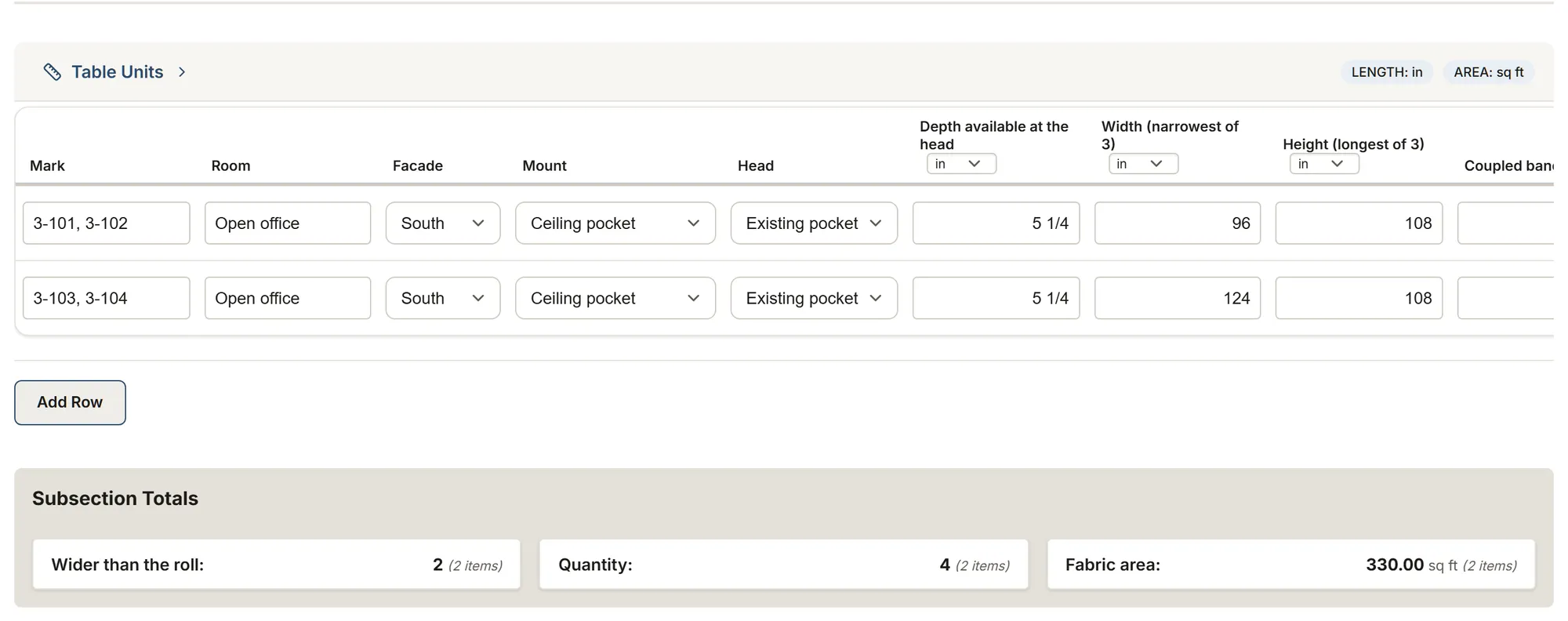
The template's tables and their columns, as the app shows them. Calculated columns fill in as you type.
Shades
- Mark
- Room
- FacadeChoices: North East South West Interior
- MountChoices: Inside Outside, on the wall Ceiling Ceiling pocket Mullion to mullion
- HeadChoices: Open roll Fascia Existing pocket New pocket
- Depth available at the head
- Width (narrowest of 3)
- Height (longest of 3)
- Coupled bands
- Fabric and colour
- OpennessChoices: 1% 3% 5% 10% Blackout Other
- Fabric roll width
- Wider than the roll calculated
- Side channelsChoices: No side channels Side channels Side and sill channels
- ControlChoices: Manual clutch Motor, line voltage Motor, low voltage Battery motor
- Control sideChoices: Left Right
- Control group
- ObstructionsChoices: Sprinkler head Diffuser or vent Thermostat or sensor Millwork or furniture Window hardware None
- Quantity
- Fabric area calculated
- Notes
Cubicle curtains
- Mark
- Track shapeChoices: Straight L U Oval
- Track length
- Added fullness
- Minimum added
- Curtain width calculated
- Ceiling height
- Track and carrier depth
- Floor clearance
- Curtain length calculated
- Mesh top height
- Curtain fabric
- Curtains
About this template
A shade schedule by floor and zone: marks, openings, mount, pocket or fascia, fabric and openness, side channels, coupled bands, controls and control groups, the flame rating the occupancy asks for, and cubicle curtains for care settings.
Guide and sources
Give each floor its own section and each zone its own tab ("Add a zone"). Number every opening with the mark used on the drawings and the shade schedule. Measure the narrowest of three widths and the longest of three heights, to the nearest 1/8 in, and order the size you want: the makers take their deductions. Note the head (an open roll, a fascia or a ceiling pocket) and the depth there is.
Openness is the share of the fabric that is open: 1, 3, 5 or 10% for solar fabrics. Type the fabric's roll width from its sheet: the sheet counts the shades wider than the roll, which the maker makes another way. Side channels close the light gap at the sides. Shades driven together share a control group: the sheet counts the shades of each group, and the fabric area of each fabric.
Fire: in Canada the fire code asks for flame-tested drapes in assembly occupancies, lobbies, exits and large open floors, and the hospital textile standard for window drapes and cubicle curtains in care settings. Record the rating the job asks for and ask for each fabric's certificate: the sheet records it, it certifies nothing.
Cubicle curtains: a public specification gives the width as the track plus 10% (at least 12 in) and the length as the ceiling height less the track and carriers, less 12 in above the floor, with a mesh top where sprinklers need it. The authority having jurisdiction decides the mesh height.
Sources
- Hunter Douglas Contract, roller shades Manufacturer data
- MechoShade, fascia Manufacturer data
- MechoShade, pockets Manufacturer data
- Hunter Douglas Hospitality, roller shades Manufacturer data
- Draper, window shades glossary Manufacturer data
- MechoShade, multi-band shades Manufacturer data
- MechoShade, solar fabrics Manufacturer data
- MechoShade, blackout fabrics Manufacturer data
- MechoShade, side channels Manufacturer data
- NY State OGS, spec 102123 Government
- Inpro, cubicle curtains Manufacturer data
- NFC 2020, 2.3.2 Code
- CAN/ULC-S109 paywalled Standard
- Quebec Safety Code, chapter VIII Government
More templates: Window coverings
Window coverings: window measure
Windows room by room: three widths and heights, mount, depth, diagonals, control, the size for the order and curtains.
You get: Covered area
Drapery workroom: fabric calculation
For the drapery workroom: finished width, fullness, widths, the cut to the repeat and the yards of each fabric and lining.
You get: Widths Fabric needed
Your trade isn't listed? The AI assistant builds your form.
Start your 14-day free trialNo credit card. Cancel anytime.