Sealcoating: site survey
Areas by use and condition, cracks, potholes and patches, oil spots; sealer, water, sand and pails for each coat.
No credit card. Cancel anytime.
Feet and inches or metric: your choice. One switch on the sheet converts every measurement.
What you measure
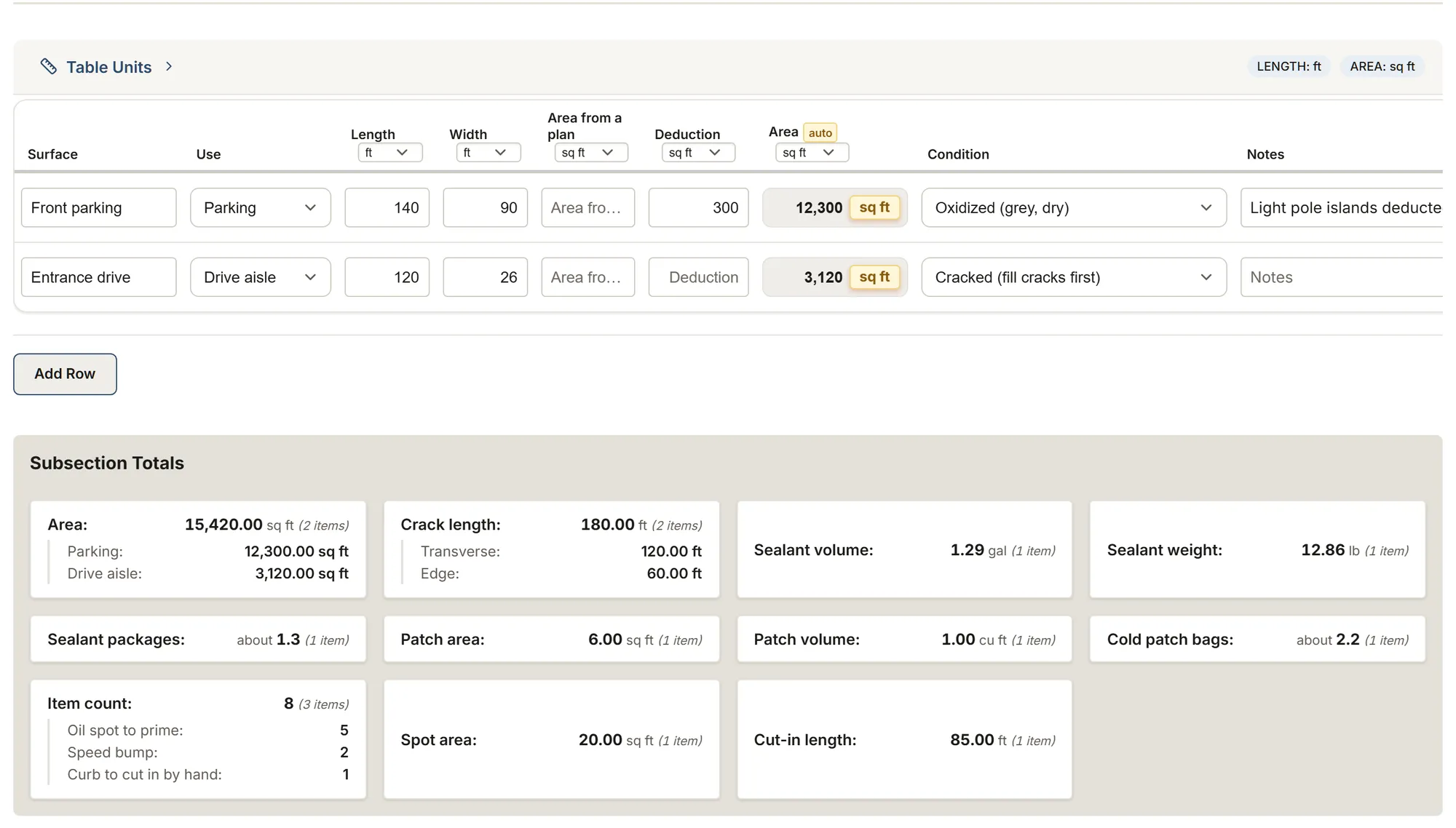
The template's tables and their columns, as the app shows them. Calculated columns fill in as you type.
Surfaces
- Surface
- UseChoices: Driveway Parking Drive aisle Loading area Walkway Private road Other
- Length
- Width
- Area from a plan
- Deduction
- Area calculated
- ConditionChoices: Sound Oxidized (grey, dry) Raveling Cracked (fill cracks first) Alligator cracking (patch, do not seal) Bleeding Ruts or depressions New asphalt
- Notes
Cracks
- Crack typeChoices: Transverse Longitudinal Edge Block Reflective Around a manhole or drain Other
- Crack length
- Width
- Depth
- TreatmentChoices: Seal, routed Seal, not routed Fill Clean only Patch instead
- Overband width
- Overband thickness
- Waste
- Sealant volume calculated
- Sealant product
- Sealant weight per volume
- Sealant weight calculated
- Package weight
- Sealant packages calculated
- Notes
Patches
- RepairChoices: Pothole Alligator area Utility cut Edge break Depression (standing water) Other
- MethodChoices: Cold patch, throw and roll Cold patch, squared and compacted Hot mix, saw-cut and replace Infrared Other
- Length
- Width
- Depth
- Patch area calculated
- Patch volume calculated
- Patch product
- Hot mix density
- Waste
- Hot mix calculated
- Bag yield
- Cold patch bags calculated
- Notes
Oil spots and details
- ItemChoices: Oil spot to prime Catch basin or drain Manhole or valve cover Speed bump Wall or door to protect Lawn or garden edge Curb to cut in by hand Other
- Item count
- Spot area
- Cut-in length
- Primer coverage
- Primer calculated
- Notes
Coats
- CoatChoices: First coat Second coat Third coat (drive lanes) Spot coat Other
- Product
- Coat area
- Coverage
- Loss
- Sealer calculated
- Water added
- Water calculated
- Sand loading
- Sand calculated
- Additive rate
- Additive calculated
- Pail or drum size
- Pails or drums calculated
- Sand bag size
- Sand bags calculated
- Production rate
- Crew hours calculated
- Notes
About this template
Walk a driveway or a lot before sealing: each zone's surfaces by use and condition, cracks by type with the sealant they take, potholes and failed areas to patch, oil spots and edges; then each coat's sealer, water, sand and pails from your product's data sheet.
Guide and sources
Walk the site with the client. Give each zone its own subsection ("Add a zone": the driveway, the front lot, the rear lot): measure each surface by use, less the islands and buildings, and note its condition. A plan or a satellite view can give the area instead of length and width. Alligator cracking and cracks with badly broken edges are patched, not sealed.
Measure the cracks by type with their width and depth. Working cracks, the ones that open and close with the seasons, are sealed (routed when wide enough); the others are filled. Length, width, depth and the overband give the sealant volume; its weight per gallon and the package weight give what to buy, rounded up once per product.
Note the potholes and failed areas to patch with their length, width and depth: hot mix in tons from its density, cold patch in bags from the bag's yield. Then the oil spots to prime, and the drains, covers, walls and edges to work around.
Under Sealcoat, one row per coat ("Add a system" for a second product): its area, the coverage per gallon of sealer as bought, your loss, and the mix design (water, sand and additive per gallon of concentrate) give the sealer, water, sand and pails. Nothing is pre-filled: coverage, dilution, sand, temperatures, rain-free hours and cure times come from the data sheet of the product you use, and it always wins over the figures quoted in the help.
Coal tar sealers can no longer be sold in Canada, and several US states, counties and cities ban their sale or use. When the lot is restriped, add the Parking lot striping survey to the same project.
Sources
- FHWA-HRT-13-092 Government
- FHWA-RD-99-147 Government
- FHWA-HIF-19-028 Government
- Crafco, sealant calculator Manufacturer data
- SealMaster, catalog Manufacturer data
- FHWA-RD-99-168 Government
- FHWA-HIF-19-041 Government
- Quikrete, cold patch Manufacturer data
- Illinois DOT, HMA guide Government
- Tennessee DOT, IB 16-11 Government
- SealMaster, PMM Manufacturer data
- Latex-ite, Ultra Shield Manufacturer data
- Neyra, Tarconite Manufacturer data
- SealMaster, MasterSeal Manufacturer data
- Neyra, Neyra AE Manufacturer data
- Dalton, XL-1000 AE Manufacturer data
- FAA, AC 150/5370-10H Government
- SealMaster, coal tar FAA Manufacturer data
- Minn. Stat. § 116.202 Government
- N.Y. ECL § 37-0119 Government
- RCW 70A.440 Government
- D.C. Code § 8-153.01 Government
- 38 M.R.S. § 419-E Government
- Md. Code, Envir. § 9-2403 Government
- Va. Code § 62.1-196.1 Government
- Dane County, coal tar Government
- USGS, coal tar sealcoat Government
- Sable Marco, cold asphalt Manufacturer data
- Techniseal, oil spot primer Manufacturer data
- Henry, Black Knight Manufacturer data
- Sika, Sikagard-690 Manufacturer data
- Henry, Airport+ Manufacturer data
- SOR/2025-36 Government
- MTQ, distress identification manual Government
- MTQ, crack sealing specification Government
- Bomix, Asphalte Manufacturer data
More templates: Sealcoating and striping
Parking lot striping: survey
Stalls by type and angle, lines by kind and color, stencils, curbs and wheel stops, paint per color.
You get: Line length Line paint Stencil paint
Your trade isn't listed? The AI assistant builds your form.
Start your 14-day free trialNo credit card. Cancel anytime.