How to measure for a garage door
A garage door is ordered at the size of its opening, but it installs in the room around it: above, behind and on each side. Here is what to measure, where, and how to compare it with what the maker asks. A worked example and a free calculator are at the end.
What to bring
- A 25 ft tape measure or a laser measure
- A step ladder to reach the header and the ceiling
- A flashlight to spot beams, ducts and lights
- Your phone to note and photograph each opening in a MesuPro survey
Measure without touching the springs: on a door in place, torsion and extension springs are under high tension. Adjusting or replacing them is a job for a trained installer.
Step by step
Measure the opening, not the old door
The width from jamb to jamb and the height from the floor to the underside of the header, on the finished opening. Garaga, Clopay and Amarr order the door at that size: a 9 x 7 ft opening takes a 9 x 7 ft door. Measure the width at the top and the bottom, the height on both sides, and keep the smallest.
Measure the headroom
From the top of the opening up to the ceiling, or to whatever hangs lowest over the door's path: a beam, a duct, a joist, a light. It decides the track: standard, a larger radius, or low headroom.
Measure the backroom
From the opening toward the back wall, along the ceiling, to the first obstruction: a duct, a beam, a closet door that swings open, overhead storage. The horizontal tracks and the opener take that room.
Measure each side
From the edge of the opening to the wall or the first obstruction, left and then right: the track brackets and the springs mount there. Between two doors side by side, measure the space between them: Garaga asks 12 in between two doors.
Note what touches the hardware
The springs on the door now, the opener and where it mounts (a ceiling rail or on the wall), the nearest outlet and the photo eyes: their lowest beam runs no higher than 6 in above the floor (DASMA).
Compare with the door maker's figures
Each maker prints its own figures for the track, the springs and the opener, and they disagree: Garaga asks the door height plus 24 in behind, Clopay and Amarr plus 18 in, and Wayne Dalton prints a total backroom. A margin below 0 means less room than asked: the maker's instructions then say what to do, a low headroom track for one.
The calculation
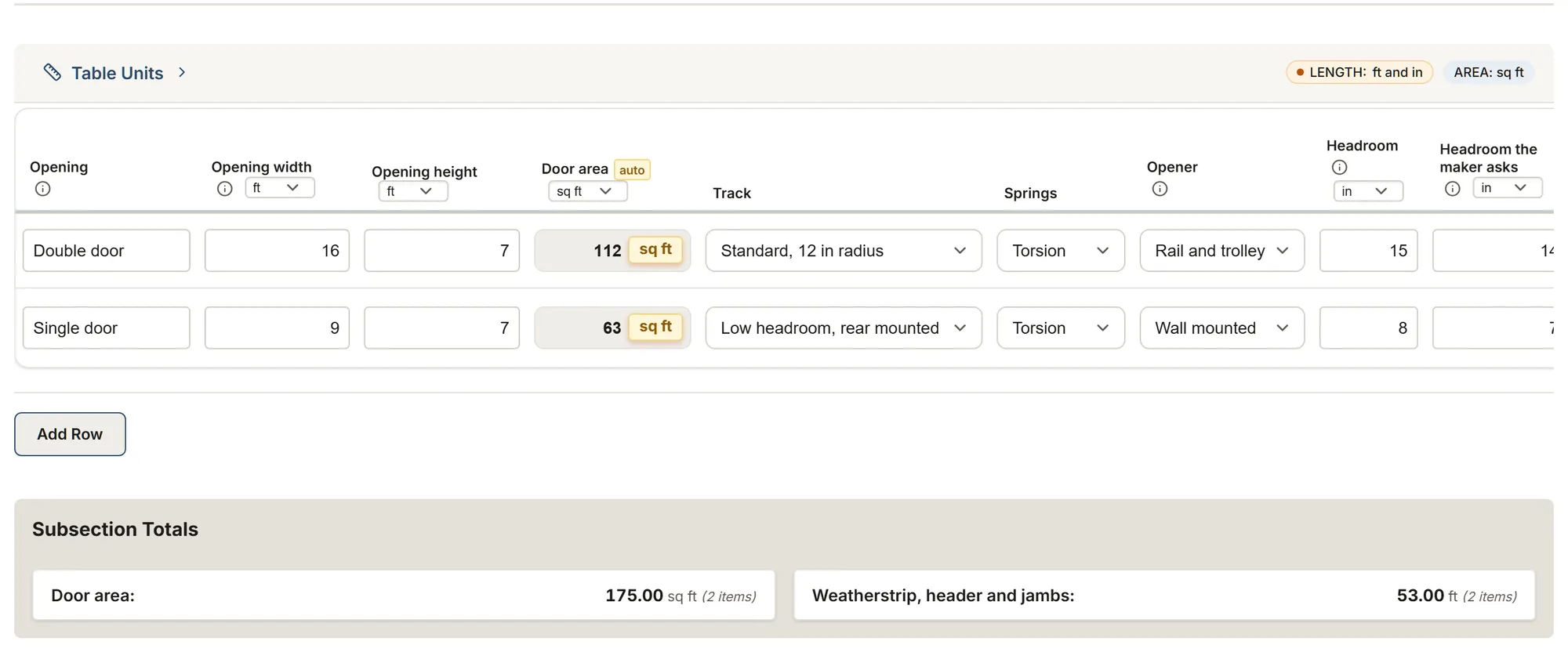
Door area = opening width x height: the door is ordered at the opening size (Garaga, Clopay, Amarr). Headroom margin = headroom measured - headroom the maker asks. Backroom the maker asks = door height + the maker's allowance. Backroom margin = backroom measured - backroom asked. Side room margin = the narrower side - the side room asked. Weatherstrip = width + 2 x height (the header and both jambs). The same formulas as the garage door survey template. Picking a maker fills only the figures it prints, with or without an opener; the others stay yours to type.
Worked example
A fictional 9 x 7 ft single door on a rear-mounted low headroom track, with a wall-mounted opener, from a maker that follows Garaga's table: it asks 7 in of headroom, the door height plus 40 in behind and 6 in on each side. On site: 8 in of headroom, 20 ft of backroom, 4.5 in on the left and 12 in on the right. The door is 63 sq ft; the headroom margin is 1 in; it needs 10.33 ft of backroom and 9.67 ft are left; and the left side gives a margin of -1.5 in: less than asked, to check with the maker before ordering. The weatherstrip is 23 ft.
Common mistakes
- Measuring the old door instead of the opening.
- Measuring the headroom to the ceiling and missing the beam, duct or light that hangs lower.
- Forgetting that an opener needs more headroom and more backroom.
- Applying one maker's figures to another maker's door.
- Adding Wayne Dalton's backroom to the door height: it is already a total.
- Measuring one side only: the margin is taken on the narrower one.
The whole job in MesuPro
Garage door survey
Opening by opening: door size, headroom, backroom, side room, track, springs, opener and weatherstrip.
You get: Door area
Your trade isn't listed? The AI assistant builds your form.
Start your 14-day free trialNo credit card. Cancel anytime.