How to measure for gutters
Before you bid, walk around the house along the eaves: each run, its outlets and downspouts, and where the water goes. A worked example and a free calculator are waiting at the end.
What to bring
- A tape measure or a measuring wheel
- A sturdy ladder, or a way to measure from the ground
- A compass or a plan to name the sides of the house
- Your phone to record and photograph each run in a MesuPro survey
Safety first: in US residential construction, work 6 ft or more above a lower level needs guardrails, nets or a personal fall arrest system. A ladder to a roof extends at least 3 ft above it, its foot about a quarter of its length out. Measure from the ground what you can, and note the access in the survey.
Step by step
Measure each run along the eaves
One row per run: its length, the eave height, its end caps and corners. Note any rotten fascia to repair before installing.
Place the outlets
Each outlet has its downspout. Two guides: Gentek usually counts one downspout for 475 to 600 sq ft of roof, and SMACNA at most 50 ft of gutter per downspout. The gutter slopes at least 1/4 in per 10 ft toward the nearest outlet.
Count the hangers from your spacing
Hangers = length / spacing, rounded up, + 1. Amerimax puts one every 24 in, every 18 in where ice and snow are heavy.
Measure each downspout
From the outlet to the ground. Note the elbows (two to reach the wall, one at the bottom to turn the water away) and the strap spacing. Downspouts are sold in 10 ft lengths: order the length rounded up.
Check where the water goes
Discharge is up to your city. Some ban any downspout connected to a sewer; on expansive soils the IRC wants the water at least 5 ft from the foundation. Check your city's rule and record each downspout's discharge.
The calculation
For each run: hangers = length / spacing, rounded up, + 1. Each outlet has its downspout, of the drop height entered: downspout length = outlets x drop, then rounded up at the total to the lengths sold (10 ft, or 3 m in meters). Straps = downspouts x (drop / strap spacing, rounded up, + 1). Elbows = downspouts x elbows per downspout. Roof per downspout = the run's area / its outlets, and gutter per downspout = length / outlets: the calculation shows the most loaded run and the longest. No spacing comes filled in: they are yours.
Worked example
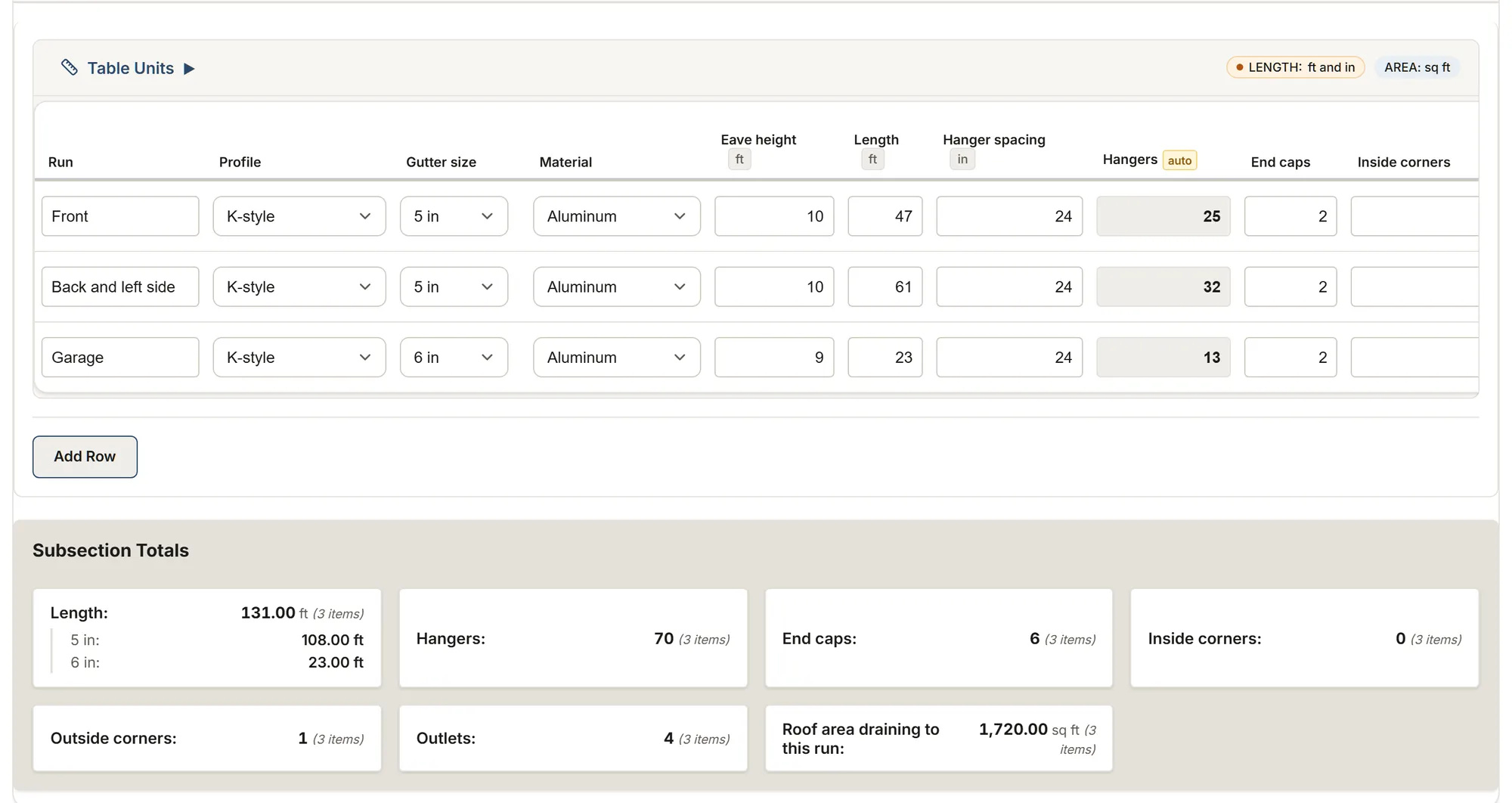
On the fictitious house of the demo "Gutters - Ranch house, Cincinnati OH", the 47 ft front (1 outlet, 620 sq ft of roof), the 61 ft back and left side (2 outlets, 800 sq ft) and the 23 ft garage (1 outlet, 300 sq ft), with a hanger every 24 in, make 131 ft of gutter and 70 hangers. Downspouts of 11 ft on the house and 9 ft on the garage, 3 elbows each and a strap every 5 ft: 4 downspouts, 42 ft, so 50 ft to buy in 10 ft lengths, 12 elbows and 15 straps. The most loaded run takes 620 sq ft of roof per downspout, and the longest 47 ft of gutter per downspout.
Common mistakes
- Ordering downspout to the foot: it is sold in 10 ft lengths.
- Forgetting the slope: a flat gutter holds water.
- One downspout for a long run or a large roof plane.
- Dumping the water next to the foundation, into a sewer or toward the street.
The whole job in MesuPro
Gutter survey
Runs by size, hangers, end caps, corners and outlets, downspouts with elbows and straps, old gutters to remove.
Feet and inches by default
Start with this template Try it, no accountYour trade isn't listed? The AI assistant builds your form.
Start your 14-day free trialNo credit card. Cancel anytime.