Insulation survey
Attic, walls, foundation and rim joists: existing and target R-value, bags or units per product, vents, hazards and air sealing.
No credit card. Cancel anytime.
Feet and inches by default, metric available for each table.
What you measure
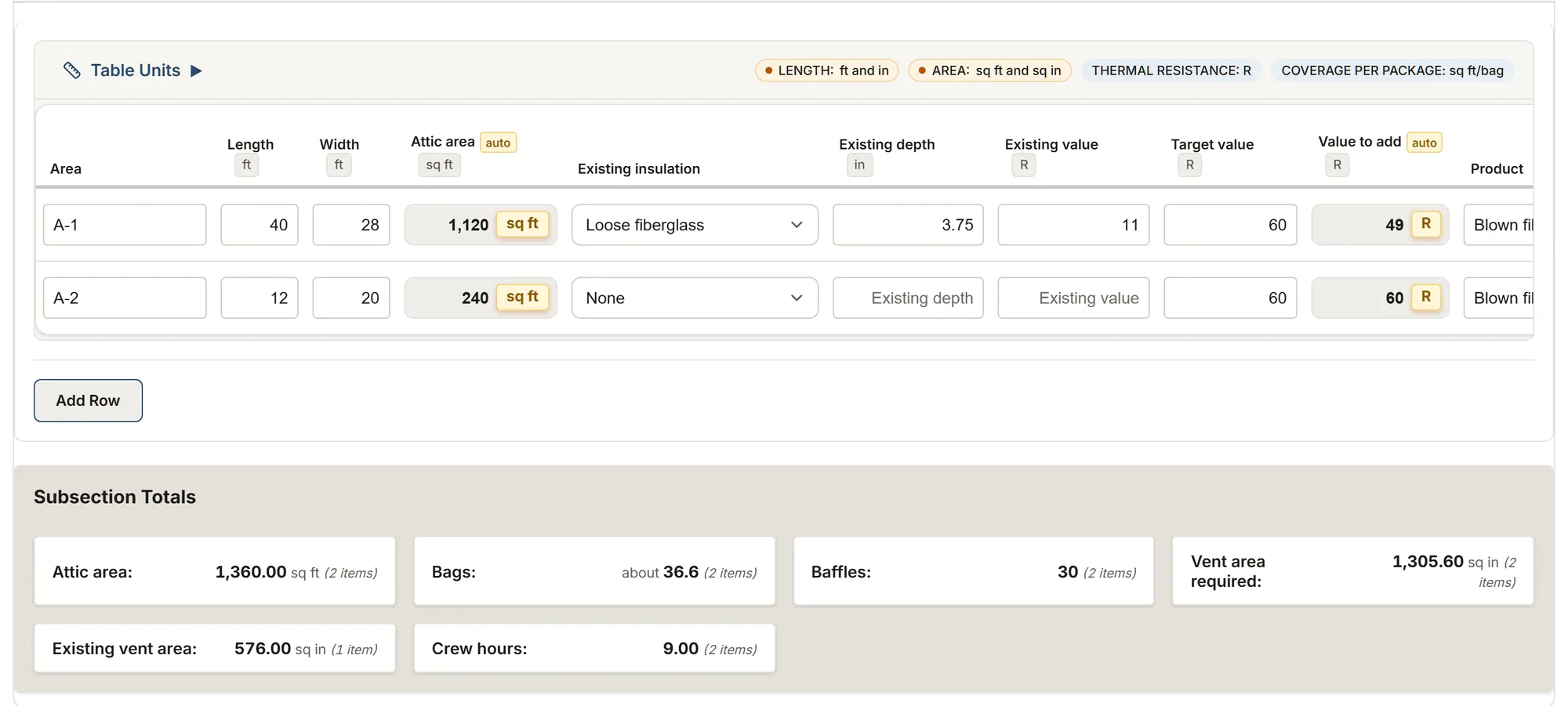
The template's tables and their columns, as the app shows them. Calculated columns fill in as you type.
Attic areas
- Area
- Length
- Width
- Attic area calculated
- Existing insulationChoices: None Loose fiberglass Loose cellulose Fiberglass batts Mineral wool batts Vermiculite (do not disturb) Other
- Existing depth
- Existing value
- Target value
- Value to add calculated
- Product
- Coverage per bag
- Minimum installed thickness
- Bags calculated
- Baffles
- Vent ratio (1 / x)
- Vent area required calculated
- Existing vent area
- Crew hours
- Notes
Exterior walls
- Wall
- Length
- Height
- Openings to deduct
- Net wall area calculated
- Stud cavityChoices: 2x4 (89 mm) 2x6 (140 mm) Other
- MethodChoices: Dense-pack cellulose Blown fiberglass Batts Spray foam Exterior continuous board
- Existing value
- Target value
- Value to add calculated
- Product
- Coverage per unit
- Units calculated
- Crew hours
- Notes
Foundation walls
- Wall
- Length
- Insulated height
- Foundation wall area calculated
- MethodChoices: Interior rigid board Spray foam Framed wall with batts Board and framed wall
- Existing value
- Target value
- Value to add calculated
- Product
- Coverage per unit
- Units calculated
- Crew hours
- Notes
Rim joists
- Location
- Length
- Rim height
- Rim area calculated
- MethodChoices: Spray foam Cut board and sealant Batts
- Existing value
- Target value
- Value to add calculated
- Product
- Coverage per unit
- Units calculated
- Crew hours
- Notes
Air sealing
- Leakage pointChoices: Attic hatch Top plates Plumbing stack Electrical penetrations Chimney or flue chase Recessed lights Bath fan duct Rim joist Other
- Count
- Material
- Notes
About this template
Measure the attic, walls, foundation walls and rim joists, note the existing insulation and the value to reach, and get the bags or units per product from the makers' coverage charts, with the vents, hazards and air sealing points.
Guide and sources
Attic: measure each attic area's length and width. Note the existing insulation's type and depth and type its value: NRCan gives typical values per inch (blown fibreglass about R-2.9, cellulose R-3.6, batts R-3.2 to R-3.4). Leave vermiculite undisturbed: it may contain asbestos.
Targets: type the R or RSI the job must reach. The National Building Code 9.36 minimums are effective RSI by zone (attic ceilings 6.91 to 10.43, walls 2.78 to 3.85, foundation walls 1.99 to 3.97). In Quebec, houses follow Part 11 of chapter I of the Construction Code, the NBC 2020 modified for Quebec since 2025-04-17: check the edition that applies to the permit. In the US, IECC 2021 asks R-49 (zone 3) to R-60 (zones 4 to 8) for ceilings; ENERGY STAR suggests R-49 to R-60 when topping up an attic. A program can ask more: LogisVert's roof measure asks RSI 8.8 (R 50).
Bags: take the coverage per bag from the product's chart, on the row for the value you add, and install at least its minimum thickness: the charts require both. Coverage and bag weight differ from one product to another, so nothing is pre-filled. The bags are exact on each row and rounded up once per product.
Ventilation: keep the vents clear with baffles (NBC: 63 mm above the insulation; IRC: at least 1 in at the vents). The NBC asks a vent area of 1/300 of the insulated ceiling (1/150 on low slopes), the IRC 1/150, or 1/300 with conditions: type the ratio that applies.
Safety: keep insulation 75 mm (3 in) from chimneys with a non-combustible dam, off knob-and-tube wiring and off recessed lights that are not in approved covers. Seal the attic hatch, top plates, plumbing stacks and wiring holes before insulating, and count each point in the air sealing table.
Sources
- DOE/PNNL, IECC 2021 R-values Government
- ENERGY STAR, R-values Government
- Owens Corning, AttiCat Manufacturer data
- Johns Manville, Climate Pro Manufacturer data
- CertainTeed, InsulSafe SP Manufacturer data
- IRC R806.3 Code
- IRC 2021, R806.2 Code
- ROCKWOOL, Comfortboard 80 Manufacturer data
- Dow, Froth-Pak Manufacturer data
- EPA, vermiculite Government
- DOE, climate regions by county Government
- NRCan, Keeping the Heat In Government
- NBC 2020, 9.36 and 9.19 Code
- Owens Corning, ProPink (Canada) Manufacturer data
- Johns Manville, Climate Pro (Canada) Manufacturer data
- Greenfiber, ThermoShield (Canada) Manufacturer data
- ROCKWOOL, residential guide Manufacturer data
- ESDC, vermiculite Government
- RBQ, energy efficiency Government
- Hydro-Québec, LogisVert Government
- Rénoclimat Government
Your trade isn't listed? The AI assistant builds your form.
Start your 14-day free trialNo credit card. Cancel anytime.